Showing posts with label 5. REALIZATION. Show all posts

Sunday, April 29, 2012

Eric Maisel Does For Mood What Michael Pollan Did For Food


MY REVIEW AND RESPONSE TO 
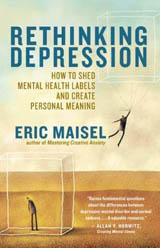
"Rethinking Depression" by Eric Maisel
“In Defense of Food: An Eater’s Manifesto,” the 2008 bestseller by Michael Pollan challenged us to take back our food supply from the “Nutritional Industrial Complex.”

Another bestselling author, Eric Maisel, psychologist and international creativity expert, in “Rethinking Depression: How to Shed Mental Health Labels and Create Personal Meaning,” urges us “make meaning” in order to take back our mood supply from the Medical Industrial Complex. [my coined phrase, not Maisel’s] 

Maisel encourages us to make a meaningful life in order to combat inevitable human unhappiness, then he tells us how. 

If this book hasn't been on the bestseller list by the time you read this review, I wish it were. It looks at life with an honesty and clarity that is rare, and much needed.

I am fortunate to be among a handful of artists, authors, and others across the globe to be asked to read and respond to "Rethinking Depression" as part of Eric Maisel's blog tour for it's launch this month.

Based on its title, at this point in my life I probably wouldn't have selected "Rethinking Depression" from a bookstore's shelves as my next read, but I'm extremely grateful to have read it.  It's true that you can't judge a book by its cover.  It arrived at just the right time to repeatedly provided insight that I'm on the right path, for me, as I work to make a meaningful life. I saw reflected back to me among its pages a philosophy and approach that rings true.

Maisel writes of his 2012 release with New World Library“I question whether ‘the mental disorder of depression’ exists or whether in contemporary times human sadness has been monetized and languaged into a ‘mental disorder.’ I follow that discussion with a plan for minimizing sadness and living life with purpose.” 

It is a book in two parts.

PART ONE: Maisel Rethinks Depression
Part One is a well-reasoned look at the medicalization and pathologization of common human experiences of emotional pain and sadness by the pharmaceutical industry and mental health establishment.  Maisel describes how our perception of these behaviors and experiences has been transformed by diagnostic lists of symptoms with an accompanying menu of approved treatments.

I find Maisel’s carefully reasoned arguments to be extremely persuasive. 

Though my reading of “Rethinking Depression”s opening chapters brought to mind many questions—I’m always one to ask, “Yeah, but what about…”—I was moved to speak aloud, “Yes!” when Maisel recommended that instead of the term “depression,” we use more specific and compassionate words such as “sadness” or “loneliness” or “disappointment” or “loss.”  These feelings are not medical conditions. They are normal human reactions to life’s harshest realities.  I won't be addressing those questions or their answers here, but in the course of writing this review I had the opportunity to interact with Eric Maisel directly. I will just say that this book represents only a small portion of a well-reasoned and compassionate conceptual edifice well worth exploring.

And there is great power in naming things as they truly are.

This is not to say that Maisel opposes prescription medication, talk therapy, or even religious practice as help for those struggling with difficult experiences and emotions. He simply wants us to recognize that these options are only that, options.

PART TWO:  We Learn to Rethink Depression
In Part Two of “Rethinking Depression”, Maisel presents another option: the reader can learn to "make meaning" by developing and acting on an "Existential Plan.”

Chapter 4, the first in Part Two, is one of the most beautifully stated explanations of a philosophical perspective—in this case existentialism—I have ever read.  With his customary pragmatic, conversational tone, Maisel lays out the ideas of Dostoyevsky, Nietzsche, Kafka, Sartre, and Camus in terms anyone can understand. Then he shows the reader how to move beyond the philosophical into the day-to-day application of these ideas to life.

To paraphrase: Life is both beautiful and extremely harsh.  No one can tell you what it all means. You have to take responsibility for yourself, decide for yourself what meaning you wish to make of life, then do your best each day to live ethically according to your own self-knowledge, values, and goals.  Even knowing that you will fall short of this ideal much of the time, Maisel asserts that this is the best way to deal with your own human unhappiness, simply by seeing life for what it is, being true to yourself, doing what you can and making what you can of your life as you go along.

For other more academic explanations of existentialism offering greater detail than I'm able, you might want to look at the following:
http://plato.stanford.edu/entries/existentialism/
http://en.wikipedia.org/wiki/Existentialism

Here is Jean-Paul Sartre's (b. 1908, d. 1980) own explanation of existentialism given in a lecture in 1949, if you care to wade through it:  http://www.marxists.org/reference/archive/sartre/works/exist/sartre.htm

The last time I’d tried to understand existentialism was in college. I attempted to read something by Sartre, perhaps "Being and Nothingness," on the recommendation of a friend, who I later learned had selectively adopted its ideas to justify an assortment of amoral life choices.

All I remember is that it left me feeling deeply depressed—or I should say profoundly unhappy and hopeless.  My father was dieing of cancer at the time.  My dreams for myself were proving to be much more difficult that I’d expected to make real, if not impossible, under the circumstances.  And I was experiencing my first crisis of faith, as the religious beliefs I was raised with longer seemed to ring true.  Sartre’s writing echoed my own dawning awareness of life’s harsh realities, without offering any comfort, at least in its opening pages.  It was too much for me at the time.

I wish someone had placed a copy of “Rethinking Depression” in the hands of my younger self all those years ago. Though, having read this book, I now feel as if someone has.

Part Two of this book begins with the realism of existential philosophy in Chapter 4, then fleshes out an approach to life that puts the power back into our hands as we each decide for ourselves how to be true to ourselves (live an authentic life) and make that life meaningful, even—perhaps, especially—when life seems most meaningless.

MAKING MEANING AND LIVING AN AUTHENTIC LIFE
In each of the chapters that follow, Maisel offers step-by-step guidance on how to do this, all the while admitting that meaning making, though worth the effort, is anything but easy.

I’m a big fan Do-It-Yourself.  I grow a garden each summer so my family, friends, and I can enjoy healthy fruits and vegetables. I bake my own bread by hand, from scratch, and even sew my own clothes when I have the time.  I entertain myself and perhaps offer the same to a few other people by creating original artwork and music from the raw materials of my imagination. And I volunteer for the causes I value most in the belief that making the world a better place is the ultimate DIY project.

Until I read “Rethinking Depression” that I had never thought to use the particular words “making meaning” to describe my DIY life. Now I realize  that’s exactly what I’ve always felt.  For me, Maisel’s use of that powerful phrase delivered a fabulous AH-HA moment, one of many provided by this book.

Maisel’s admonition to “focus on meaning, not mood” was another lightbulb moment for me. Again, this is something I attempt to do, though, for me, having the right words for it brings the practice to a higher level of awareness and choice.  In the face of life’s unavoidable unwanted experiences—and the pain, sadness, disappointment, and anger that inevitably accompanies them—I can choose in each moment to bravely, though imperfectly, turn my attention and actions toward the things I value most, toward creating the life and being the person I most wish to be.

Serendipitously, as I was writing this review, I happened to be working my way back through my personal journals from last summer, looking for bits of insight and lessons learned. After reading “Rethinking Depression,” I read the words I’d written then in a new way. 

I was taking the unavoidable difficulties of life and transforming them through choice and action into meaning.  In this way, I was able in the course of three handwritten pages to move from sadness to strength. I wrote:
I’m still feeling down this morning. What I imagine I’ve lost in the past 10 years is the optimistic boldness of belief that everything would work out as I imagined it would.  Time and again, I’ve faced emotional and physical setbacks that stripped me of my momentum….10 years ago I had no idea that all of this lay ahead.  All I saw was possibility.  I saw my own potential.  I believed that possibility and ability would come together to create the reality I envisioned.  If it were entirely up to me, then that’s exactly what would have happened.  It’s not.  It’s not entirely up to me.  My past, my body, the people I encounter and the things they choose to do, these are outside of my control.  They are the other creative forces.

All I can do is continue to show up.  When I’m tired, when I’m sad, when I’m so discouraged I want to give up, I can still show up.  I don’t have to feel it in order to continue acting on my creative vision. I start with what is, in this moment, and put my hand to it, apply my mind and emotion to it.  Even in sadness.  Even in despair of ever seeing my vision realized.

I am here.
As long as I am here there is hope for what might be.
That is enough.
I've learned along the way that life's obstacles and distractions offer some of the most meaningful adventures, as long as we can learn to walk through the unhappiness of unexpected detours and actively turn them into opportunities for learning and growth. Maisel's latest provides us with the tools and instructions we need to do this for ourselves.

"Rethinking Depression" should be required reading in the great school of living. We are each far more than a set of mental health criteria. We are far more than a diagnosis or the lack of one. Making a meaningful life is simply the best way to take back our mood supply.



ABOUT THE AUTHOR OF RETHINKING DEPRESSION


Eric Maisel, PhD, is a licensed psychotherapist and the author of Rethinking Depression and numerous other titles including Mastering Creative Anxiety, Brainstorm, Coaching the Artist Within, and A Writer’s San Francisco. He blogs for the Huffington Post and writes for Professional Artist Magazine. Visit him online at http://www.ericmaisel.com


RETHINKING DEPRESSION by Eric Maisel
February 15, 2012 •  Pychology/Personal Growth •  256 pages • Trade Paperback
Price: $14.95 • ISBN 978-1-60868-020-7


Friday, April 09, 2010

THREE PROJECTS: Laying the Groundwork

About a month ago, I found myself at a crossroads.

The people attending our songwriting retreat back in March asked me where they could find recordings of the songs I’d sung for them and when my Creative Compass book would be available for purchase. I realized that I needed to find an answer for myself to the same question they'd asked over and over during our workshops: “How do I find time in my busy schedule for my songwriting?” (or writing a book, or learning to paint, or starting a band, or building a website, or planting a garden, or exercising…)

Their questions and interest motivated me to search for a workable answer.

Right in the middle of one of the busiest periods I’ve been through in many years—six weeks straight teaching lessons, performing concerts, presenting at conferences and retreats, selling pottery at shows, and hosting family gatherings, all without a single day off—I knew I was overdue for a change. I hoped to find a solution that would work for me, while offering tools and ideas that others could adapt to their own lives.

My creative work is piled up like a logjam in side me. It’s fully realized but not in a form that exists without my physical presence. If I’m not on hand to perform the songs, present the workshops, or sell my pottery on the spot they might as well not exist.

A month ago, on Monday, March 29, 2010 I began by making conscious effort to change comfortable old habits that were obviously stealing time and energy. I needed to remove the virtual drug that had been lulling me into complacency about the work I really wanted to be doing.

I’ve waited this long to post this because I didn’t want to try out these changes in public, only to fall back into old habits and have to confess to my backsliding just as publicly.

Four weeks into this change I feel much more comfortable passing along the specific things that have allowed me to start making tangible progress again toward three creative goals that had previously languished for months, even years, until now:

  • Recording my "Dolphin's Daughters" CD project
  • Writing my "Creative Compass" book
  • Spending time making pottery for the joy of it (and to sell online and at artisan shows)

The change has come primarily by reclaiming time dissipated online, time I was numb to having wasted each day. And a change in attitude.

COMPUTER CAPACITY

Recording a CD and writing a book are computer intensive activities. Though my capacity for being glued to a computer screen for hours on end is fairly high, there’s still a limit to how much time I can put in each day, both in terms of endurance and availability. Wasting capacity on mindless internet exploration leaves little for recording a CD or writing a book.

In other words, I can only sit at my desk for so many hours straight before I my backside begins to hurt and I'm overpowered by an urge to run out front door into the sunshine shouting, "I'm free! I'm free!"

I realized that the time I was spending online reading news stories and blogs, skimming Facebook status updates, and watching funny videos must have been meeting some need otherwise I wouldn’t be doing it. What I had to figure out was what purpose they were serving so I could find a more satisfying way to meet those needs and free up my computer capacity for work on my projects.

The conclusion I drew was that time online was serving as a poor substitute for real world random exploration and discovery, enrichment, entertainment, and personal connection with others. If I could make a place for more of these things away from the computer screen, then the changes wouldn’t feel so much like deprivation during the crucial early stages.

TIMER FOR A CHANGE

Four weeks ago I set out first to quantify the minutes and hours slipping past in mindlessly screen staring while I read Facebook status updates and browsed internet news, caught up on artists’ and eco blogs, searched for recipes, listened to music or watched the latest viral Youtube video.

I set a digital timer counting as soon as I went online that first day. I needed cumulative total. Each time I went off to do something goal related or respond to a client email I stopped it. As soon as I returned to the internet in an unfocused way I started it again.

At the end of the first day, I was astounded by what the timer showed. And too embarrassed now tell you what it said, though you can read the fine print in the picture of my journal, below. Had I really squandered the entire morning after breakfast morning, and several wedges of precious time between teaching lessons, then another hour just before bed on that first day? Talking with other people, I soon realized that I wasn't alone, only difference was the time of day I was going online, morning vs. evening for most people.

For the next two days, I continued tracking my time online without changing habits. I had to convince myself of the magnitude of the problem. Was this really the way I'd been living? I made little chart and totaled up different kinds of internet use for several days.

Each day yielded the same results: several hours irretrievably lost with nothing to show for them but a nondescript sensation that I had done something vaguely useful.

How had I become delusional enough to sincerely believe that the majority of my internet time was being used for writing and responding to business correspondence or goal related reading, writing, watching, and listening online? The hard data I’d collected on myself showed a completely different story.

Fully convinced by the middle of that first week, I switched the timer from stopwatch to countdown mode, allotting myself only 1 hour, total, each day for online entertainment and curiosity.

My previous pattern had been to check email, read news, and browse Facebook over a bowl of generic cheerios or oatmeal, then loose track of time until mid-morning or even lunch time if I got up late. I work for myself teaching voice and piano to student scheduled to arrive afternoon through evening. I rationalized that my morning was the equivalent of everyone else’s evening, when other people relax and blew off steam after a hard day of work. This sort of daily schedule would be fine, except that there are other things I want to be doing.

The change felt more than a little awkward at first. I went through withdrawals on Thursday and Friday of that first week. It was like giving up a drug. Symptoms included a nagging sensation that something important was missing, restlessness, and irritability followed by the intense urge to return to my old ways.

More than a few of times, as I worked on other things at the computer, I lost focus and mindlessly clicked on the browser icon only to return to awareness 10-15 minutes later while skimming news headlines and articles on yahoo.com, or browsing friends and family members status updates on Facebook.

So I started rationing the hour in 15-20 minute increments throughout the day, using it to take breaks from other work. When the time ran out I planned to shut down the browser and return to other activities, but on several occasions the time expired, the timer beeped, and many minutes went by before I returned to awareness.

The next morning unplugged the Ethernet cable before powering on the computer. I didn’t plug it back in until lunchtime and got a lot more done.

BALANCING FOCUS & RANDOMNESS

I could see that if I simply reined in my old habits, while offered nothing as a replacement to meet the needs they were fulfilling, this experiment would fail. If I planned to impose additional structure on an already busy schedule, I would need to offer myself some other form of release of the sort that inspires rather than numbs.

The next step was to begin replacing cyber randomness with real world spontaneous exploration and online social networking with face-to-face interaction.

To fill the need for random, spontaneous exploration, that first week I started taking my new digital camera out for a walks capturing anything and everything that caught my eye.

I spent sunny hours working in the garden for fun, allowing myself to be drawn by whichever task called to me next—picking up leaves, digging holes to transplant rhubarb, picking pieces of antique pottery from the sandy soil like an archeologist, pruning the blueberry bushes.

I spent quiet moments sitting on the grass in the sunshine watching a pair of crows circle high over bare branched early spring woods.

Or by the sea as cloud shadows, wind ripples, and lobster boats pass.

I’ve browsed through the local public library, picking books off of shelves and bringing home CDs to discover new ideas and new music. Sometimes I’ve stayed to write there in a big comfortable chair for a change of scenery.

For human connection, I’ve been more open to conversation with people I encounter when I’m out in the community, choosing activities that will give me opportunities for interaction. It’s amazing what listening and thoughtful sharing will open in another, and in yourself.

This past weekend I struck up a conversation with a woman outside of the hardware store. We’d come out of the store a the same time and I’d noticed that she had a pick-up truck full of bamboo plants. I asked where she’d gotten them, then whether she was selling them, and eventually arrangements to get some for our yard. Not only that but learned a little about her family’s farm, it’s history, and why they're having to sell it. It’s a place I’ve driven by nearly every day and admired, lamenting the 55 acres that will soon be opened to development just a half-mile from our home.

Unlike the hours squandered on the internet, random explorations in the real world and time reclaimed for projects yielded memorable, tangible results.

The vividness of hours spent walking around town with a camera—capturing the shapes, colors and textures of ordinary objects—lingers even a week-and-a-half later. As does the satisfaction I feel each time I look back at those images. The experience of that day is burned into the retina of my heart.

THE PAYOFF

My projects have progressed and I’m feeling more alive!

The payoff can be found in small, tangible accomplishments and memorable experiences. These have replaced the emptiness I felt during the first few days after changing my old routine.

No, the CD is not recorded, not in four weeks, nor will it be finished in the next month or even two, but I now know exactly what I’ve already accomplished and what needs to be done next to keep things moving forward.

A unified awareness of accomplishments and next steps was difficult to holding in my mind before, when the virtual world ruled my attention.

I began a new pottery vessel titled Carpe Diem, which can be seen here, among other things. The scraps from forming this will become labyrinth necklaces to add to my Sacred Shards inventory.

And the Creative Compass book?

I’ve begun again to add 3x5 cards with ideas, quotes, etc. to my pocket chart outline as I happen upon them. I’m open again to uncovering insights and capturing them so they are beginning to appear nearly everywhere I look, as if by magic.

Although more dedicated time is needed to make real progress on the book, many ideas and topics are beginning to take shape in my daily writing.

During the coming month, I plan to commit certain hours each week to work on the book and my blogs. This will be another step forward.

The average non-fiction paperback book contains 40,00-50,00 words. The word count for this little essay has run more 2200 with an investment of about 12 hours total. I started it back at week two, but came back to rewrite and edit several times before it seemed ready to find it’s form.

Though this article won’t be used beyond this blog without further editing, it shows that writing a book is not such a distant, unachievable goal. A simple calculation reveals that 25 essays of this length could well be woven together to create a book of marketable length. [55,000 / 2200 = 25] This is totally doable!

I’m learning in a concrete way that moving these big projects toward completion is just a matter of accumulating incremental progress.

It’s a cliché of the creative world that you can do anything 15 minutes at a time. Well, it’s true.

My threshold of measurable accomplishment seems to be found after 1-3 hours of continuous work. Obviously the hours I’ve reclaimed from useless internet wanderings, and soulless TV watching before that, more than allow for this.

TIME FOR THE FINDING

I found the time in my busy schedule to begin to record my songs, make more pottery, and write the book by turning away from the virtual, toward the real world were songs and pottery and books must come exist apart from my presence, were the need for random exploration and human connection can truly find their fulfillment.

As a wonderfully affirming bit of ironic serendipity, in the midst of all this change an old friend posted a link of perfect relevance on Facebook. Unaware that I’d been working to make these very alterations in my life, she shared the following article, “Time Lost and Found” by inspirational author, Anne Lamott.

After reading it I knew I was absolutely doing the right thing.

A month has passed since I began instituting these changes and tailoring them to accommodate my best way of being and working.

I write today with new habits firmly in place: the ethernet cable is unplugged from my computer. It’s nearly lunchtime and I have not yet gone online today. In a few minutes, I’ll power down the computer, plug the cable back in, then go online to finally post this little article on my “Quiet Little Life” blog for you to read.

When I do, the timer will be close at hand, already set to count down from 1 hour as soon as the day’s browsing begins.

Though I still expect to lose track of time spent online occasionally, I know I’m more awake than before and more aware of the time passed there. Always, I’m eager to return to the real world were more satisfying work and exploration and human connection await.

©2010 Kay Pere ~ Effusive Muse Publishing

Monday, March 29, 2010

REFLECTION: a sigh of relief...

March has been one of the busiest months I've experienced in many years. All of it good busy. Just too much constant activity on top of activity for my quiet temperament.


Too much of a good thing is still too much.

The past two months have been an uninterrupted stream of concerts to perform, retreats to lead, conference mentoring to offer, workshops to present, and pottery shows to manage. All satisfying and valuable, but requiring a steady take-charge alertness and responsiveness to others that is draining when sustained over a long haul.

Today marks a conscious shift toward silence and solitude.

Today I return my gaze toward the projects closest to my heart, projects that can only progress if granted the uninterrupted time, energy, and focus they require.
  • recording the next CD, one song at a time
  • writing the Creative Compass book, one essay at a time
  • pottery making, for artistic discovery and for sale, one lump of clay at a time.
One of my favorite quotes is from the dancer/choreographer Martha Graham, here she is speaking to Agnes De Milne:
[pictured above in a photograph by Barbara Morgan, "Letter to the World (kick), Martha Graham" 1940]

“There is a vitality, a life force, a quickening that is translated through you into action, and there is only one of you in all time, this expression is unique, and if you block it, it will never exist through any other medium; and be lost. The world will not have it. It is not your business to determine how good it is, not how it compares with other expression. It is your business to keep it yours clearly and directly, to keep the channel open. You do not even have to believe in yourself or your work. You have to keep open and aware directly to the urges that motivate you. Keep the channel open. No artist is pleased. There is no satisfaction whatever at any time. There is on a queer, divine dissatisfaction, a blessed unrest that keeps us marching and makes us more alive than the others.”


When I'm suspended too much from myself--from my need for stillness and solitude--a sadness, a deep feeling of neglect creeps in. There is only one cure.

I wrote in my journal this morning:

"My tasks first. Others later or they will set the tone for the day.
My tasks first.
Not email.
Not phone calls.
My solitude.
My body. [meaning exercise and healthy eating]
My vision.
First."

"Relationships don't need constant tending. They will be stronger if I am more whole."

"If I am angry and sad and feeling neglected within, no matter how much recreation and togetherness is poured on top it will never be healed. The healing is in my own inward attentiveness, my own setting of protective boundaries around the needs of this center self, my own making of space for its expression and discovery."

"There is always discovery in solitary being and doing. That is what I long for. I will carve out space for that discovery through Soulful doing. Starting today. Starting now."

Less mindless surfing of the internet to read news, or watch videos, or catch up on Facebook. Less shuffling through newspapers and magazines to kill time.

Much more direct engagement in the projects that matter to me.

Starting today. Starting now.

I'll be writing here and on my other, related blogs more regularly, though briefly, to map daily progress.
But I'm shutting down my browser now.
And getting to work.

Starting today. Starting now.

(c)Kay Pere~Effusive Muse Publishing

Thursday, February 18, 2010

BAKING: 1st Cake from Scratch!

Yesterday's Creative Output:
1 Chocolate Buttermilk Cake with Mocha Whipped Cream Frosting
2 8-inch round layers

Life can be home schooling for grown-ups.

That's how I see it. I've turned off the TV, where I'd just be watching other people do things, and I've tuned in to learning and doing things myself instead, using my unscheduled time to following my curiosity.

It has been a goal of mine for a long time to bake a cake from scratch. Why? I'm not entirely sure. Sense of accomplishment? Potentially delicious results? Happy husband?

It's one of those urges you don't question. You just go with it. But where to start?

For my first scratch-baked cake, I meticulously went through all my cookbooks and compared all the chocolate cake recipes (no exaggeration). If I was going to put in the effort to bake a cake this way, I wanted to understand what I was doing and what the options were. I wanted to maximize the chances of success. Nothing is more discouraging to a novice baker that an unpalatable result the first time out.

At the risk of revealing the level my enjoyment of detail and depth, and looking a little crazy in the process, here is a picture of the table I created and filled in with ingredient quantities from 18 different chocolate cake recipes (not including the flourless or chiffon varieties).
Earlier this week, when the number of choices and amount of information was feeling overwhelming, I put this chart together so I could look for patterns. I enjoyed imagining each one as I looked over the recipes.

That's probably why I have so many recipes collected and organized into binders on a shelf in our kitchen. I read recipes the way some people read trashy novels.
Though the cake in the picture above wasn't from the recipe I ultimately used, the photo supplied inspiration for the finished result.

Some recipes used powdered unsweetened cocoa, some solid, some Dutch-process, some non-Dutch-process (wasn't even sure what this meant when I started). Some specified butter or shortening or vegetable oil, or milk or water or buttermilk or yoghurt or sour cream, white sugar or light brown sugar, baking powder and/or baking powder and/or salt. And so on. A lot to understand.

Got a wide variety of reactions when I told people I was planning to bake my first cake from scratch this week--everything from "Why would you want to do that?" to "You've got to try this great frosting recipe!"

Ultimately, I took a friend's advice and chose a recipe with buttermilk for my first attempt. She said it would be more moist. For the frosting, I decided on a flavored whipped cream for simplicity's sake--I already knew how to whip cream and add things to it. Other frostings required unfamiliar steps. One can only take on so many unfamiliar steps at one time.

Mixing the cake ended up not being a big deal. Creaming butter and sugar together on a stand mixer? I knew how to do that. Easy! Measuring and sifting together dry ingredients? I could do that. Again, easy! Breaking eggs? Mixing it all together? Putting the batter into the greased and floured pans? All easy!

Why had it seemed to overwhelming to begin with? Too many choices. Multiple steps examined as a whole. The print began to swim on the page. Until I took it all a little at a time.

Choose and do! That's it.

This is an approach that applies to any other undertakings. Face down the feelings of being overwhelmed by choices and the worry about making the best one. Take the time you need to understand what you're about to do, as much as you can without having done it, then choose and do! Or just jump in and try stuff, see what works and what doesn't. Either approach works.

Many kinds of knowledge only come from the doing.

Three years ago I decided I wanted to learn to bake my own bread. Now I'm very comfortable with the process and enjoying experimenting with methods, inventing my own recipes. I would love to get to this point with other areas of cooking.

Cooking is just another thing to know, useful knowledge with edible results. It's a way of relating to the things that us bring sustenance. It's the raw material for an enjoyable experience, sitting down with others to converse.

So many of the other creative things I'm involved in are what I would call "long cycle" activities.

From concept and clay to finished piece to gallery or market is a relatively long cycle, on the scale of weeks or months, sometimes years. From concept to song to performance to recording to distribution is another long cycle of months or years.

Baking is a creative activity with a "short cycle" from beginning to end, just a matter of minutes or hours. The recipe I chose said "2 1/2 Hours Total, including cooling, 25 minutes active." A small investment when I know we will enjoy this cake all week.

Besides, what else was I going to do? Watch TV?

[I have chosen not to include the recipes I used, leaving the fun for you to choose your own. Both cake and frosting recipes came from "A Piece of Cake", by Susan C. Purdy, which has 380 recipes for all varieties of cakes and frostings--purchased used for $3 at last spring's library book sale.]

Wednesday, June 17, 2009

SACRED SHARDS: Completely Glazed Over

Look what the kiln elves did overnight!  Pretty colors!

Some sale-able items for this summer's craft shows.  A few gifts.  Lots of experimental stuff (mugs, etc.).  And a couple of keepers.

Batter bowl (upper right), Peace Dove ornaments, Word Wise bowl with hearts (peeking from under shelf), ... and hiding on the bottom shelf where I can't see them, surprises!

Going now to unload the kiln and see what I've got!

Tuesday, June 16, 2009

SACRED SHARDS: Glazing Over

The little kiln that could.  She's an L&L kiln.  Needs a name.  I'll call her Lana, as in Lana Lang.  Powered by meteor rocks.
Finished glazing and loading this afternoon.  Firing initiated at about 3:45 PM.
Here's what's inside.  There's another layer below the one visible at on the lower right.

And here's what it looked like just a little while ago, glowing amiably in the darkness of the basement.  Alien Power Source at work.
Temperature read-out on its way up, with the glow under the kiln lid showing through.

The glow  under the lid and between the kiln's sections projects onto the basement walls in stripes of yellowish orange, but my camera's shutter speed doesn't go slow enough to capture this.

The picture above was taken over an hour ago.  By now, it's probably reached Cone 5 and is on it's way back down. 

I'll be able to open it tomorrow.  It's always like opening a surprise package.

Tuesday, June 02, 2009

BREAD: Project Sourdough Day 4~Garlic Oregano Breadsticks

The house smells like an Italian bakery today.

But I'm beginning to feel a little like Seymour Krelborn in "Little Shop of Horrors."

Every day I give the sourdough starter a little water to drink and a little flour to eat ...

... and it grows.  

Because I decided four days ago not to throw away the surplus every time I feed the starter, our kitchen is now being overrun by baked goods.

First eight large sandwich rolls.  Then two loaves of cinnamon bread.  Now a dozen 14-inch garlic oregano breadsticks.

Or is that Bread Schticks!

Tomorrow I'm forming the extra into a ball and putting it in a bowl in the refrigerator for 24 hours to rise very, very slowly.  I need a break!

I'm beginning to remember why I got stir crazy the last time I worked to wake the sleeping the sourdough starter.

Here's what I added to the basic sponge today:

3 cups all purpose flour
1 tsp instant yeast
1 tsp salt
1 Tbs olive oil
1 Tbs dried oregano
1 tsp garlic powder
2 large cloves fresh garlic, peeled and pressed

The  starter seems to be taking over the leavening process.  Tomorrow's loaves will be made without any added powdered yeast.

I have no energy for a detailed explanation of the process this time.

Just: mix it, knead it, put it in a greased bowl, let it rise, punch it down, let it rest, cut it into 12ths, roll these into logs then twist and stretch, place them on two baking sheets  sprinkled with cornmeal, let them rise, bake at 400F for about 15 minutes switching top and bottom sheets midway through, cool on a rack.  Eat!

This turned out really well.  As have the other improvised bread recipes.

Tomorrow I'll post about the book, "Ratio," that's provided the knowledge and therefore the courage to become an experimental baker.

Sunday, May 31, 2009

BREAD: Project Sourdough Day 2~Sandwich Rolls

I began the process of reactivating my long-slumbering sourdough starter yesterday.

The instructions I have say to whisk 2 cups of water and 3 cups of flour into 1 cup of starter in a large bowl, then cover.  This is then left for at least 12 hours at room temperature or slightly warmer.

When the starter is fully active it will double in size, becoming bubbly, aromatic, and viscous.

If activity is minimal, one cup of the mixture is saved to undergo the same steps until in begins to double.  Sometimes this can take several days.  The instructions say to discard the extra flour/water mixture each time.

Discard?!  Perfectly good flour and water lightly tasting of sourdough?  That's just silly.

I decided to do some freestyle baking.  I called on my two years of bread baking experience to combine techniques, quantities, and various recipes so we could make good use of this surplus.

After reserving 1 cup of the restarting starter, to the remainder I added the following:

2 1/2 tsp Instant (aka Rapid Rise) Yeast Powder*
1 tsp Salt
2 Tbs Olive Oil
1 Tbs Sugar
Approx. 3 1/2 cups All Purpose Unbleached Flour

The additional yeast was necessary because the sourdough yeast was still in the process of re-colonizing the starter and wouldn't be able to provide enough leavening to make the dough rise.

*"Instant" Yeast is OK to add directly to liquid mixtures vs. "Active Dry" which has a coating that needs to be dissolved before combining and is slower acting.

The soft dough was kneaded for 8-10 minutes on a floured board, working in the last half cup of flour.  This was formed then into a ball, placed and turned over in a greased bowl to coat, covered with a damp towel and kept in a warm place to rise until doubled (about 2 hours).

After the dough had doubled, it was punched down the dough, turned onto the floured board and cut it into 8 equal pieces.  These were formed into balls and placed on a greased baking sheet.

I brushed the top of each roll with an egg wash (1 egg whisked with 1 Tbs of water) and sprinkled variously with: sesame seeds, poppy seeds, dried onion flakes and crumbled rosemary.  These were then allowed to rise again until doubled.

Baked until lightly browned at 375F for about 18 minutes, then cooled them on a wire rack.

All this was improvisation.  And they turned out just the way I'd hoped.  We shared a roll with rosemary and onion flakes right out of the oven.  The rest will be for sandwiches this week.

We'll be enjoying a lot of fresh baked bread this week as I continue to feed and reactivate the starter, and find new ways to use up the surplus.

Tuesday, May 26, 2009

ECO ACTION: Lines in the Sand

Over at the No Impact Man Blog today, Colin Beavan asked: "Do you have any eco-living lines in the sand?"

Here's my reply.

LINES IN SAND: If something passes through my hands once or for a short period of time and is then thrown away, don't use it. Eat locally grown or make my own as much as possible. If we're not using it turn it off. Walk or bus if possible.

Changes I've made just in the past three months (on top of many others in the past) include:

  • Got my first ever bus pass a few weeks ago ( I live in a suburban area)
  • Using cloth handkerchiefs instead of tissues (found at a yard sale, lacy antique cotton, not noticeably used)
  • Using cloth napkins for meals at home instead of paper (another yard sale purchase)
  • Refusing plastic straws when eating out
  • Trying to take food from home with me in reusable containers when I'm traveling, so I don't have to purchase fast food in disposables
  • Joined a CSA (community supported agriculture) and started getting my half-share pick-ups of very fresh locally grown produce.
  • Carrying a large purse with room for purchases in case I've forgotten my cloth bags
  • Bought (dollar store) and started using reusable mesh bags for fruits, veggies and bagels from the grocery store, instead of plastic produce bags (though I reuse those, too, when I can)
  • Making the switch to pre-owned cast-iron cookware (yard sale) to phase out my battered non-stick pans (non-stick coating lasts only a few years and may be dangerous, cast-iron is practically forever)
  • Phasing out my use of my #7 plastic Nalgene water bottles, will keep them for occasional use, not throw them out. Instead, at home I'm using a drinking glass for water (duh!), and a pint canning jar with a lid for when I'm out and about.

This looks like a lot for just three months, but it really hasn't been a big deal. It's just happening naturally a little at a time.

Thursday, May 14, 2009

ECO ACTION: First Bus Pass

Eco-Action Girl got her first bus pass this week!

Went for a ride today on the new SEAT (Southeast Area Transit) Pawcatuck/Mystic Run #10 to gather info about stops and services.  I caught it just a short walk from our street and rode it round trip, chatting with the driver along the way.

This was the first time I'd used a public bus in about 20 years!  Only the third time in my life, I'm ashamed to say.  

My previous experiences had not been good ones.  This time was entirely different.
Here's the stop at Olde Mistick Village shopping center, located in the back parking lot near this landmark, right across from the Mystic Aquarium.

Around here, people have the perception that riding the bus is just for seniors, the disabled or those who can't afford to own a car.

Using public transportation is for anyone.  Especially those who want to live more simply and sustainably.  That's why it's called "public" transportation.  We are the public.

Until today, I had the notion that the bus would be noisy, dirty, crowded, time-consuming and uncomfortable.

It was anything but.

I got where I was going in about the same amount of time as if I'd driven, and I got to chat along the way with a very friendly and helpful driver in her brand-new bus (similar to the buses used as airport shuttles, except with all the seats facing forward).

The cost for a one way ticket ($1.25) was  comparable to what I would have spent on gas going the same distance.  And I got to sit back and relax.

I took notes on all the stops and picked up a pile of brochures to spread around.  Also got info on connecting routes so I can use them going to adjacent towns.

I want to get the word out about this new run.

Many people can benefit from its availability, but it's not widely known.  I just happened to stumble upon a brochure at the grocery store customer service counter or I wouldn't have been aware of its existence.

Ridership will need to go up if SEAT is to see that it's worthwhile to keep it going.  A similar run existed about 5 years ago, but was eliminated because of under-use.

This time, perhaps economic realities and environmental awareness will be just the nudge people need to stand up and take a SEAT.

Friday, November 28, 2008

VIDEO: Me Singing "Time at the Table"


"Time at the Table"
Words and Music by Kay Pere and Bill Pere
Performed at the Shubert Theatre in New Haven, CT
Kay Pere with Bill Pere and the LUNCH Ensemble

Check back soon for lyrics.

:-), Kay

Monday, November 24, 2008

ECO ACTION: No Impact Man Blog

As a self proclaimed Eco Geek, I love to read the No Impact Man blog.

It gives a clear picture of just how much one person can do to live more sustainably, how one persons actions can inspire others.

I'll never be able to alter my lifestyle to the extent described there, but it's a wonderful source of information and ideas about what might be the next step beyond those I've already taken.

Saturday, September 27, 2008

GAIA LUNA: Harvesting What Isn't

Thirty spokes share the wheel's hub;
It is the centre hole that makes it useful.
Shape clay into a vessel;
It is the space within that makes it useful.
Cut doors and windows for a room;
It is the holes that make it useful.
Therefore profit comes from what is there;
Usefulness from what is not there
~ Lao Tsu, From Tao-Te Ching

Health brings life filled with activity.  Illness empties time to its barest essence.

Health allows forward motion.  Illness stops the wheel in mid-rotation.

It was the emptying, the resting, that brought clarity about the perpetual motion of my healthy life.  This was the useful outcome of two months of illness;  once I was able to get past the first heat of frustration and anger (at not being able to do everything I'd planned for myself), I began to see with vividness and gratitude the small things that could happen.

Back before I got sick, I'd planted corn from seed for the first time, started indoors before the soil had warmed, then planted out in early June.  When the corn went untended, with little rain for many weeks, I gave up hope of growing anything more than bare stalks.

Even so, in late August I harvested a dozen perfectly formed ears of corn.  The stalks where spindly and short, but they had overcome adverse conditions to fulfill their potential.

The lesson learned: Plant the seeds.

Don't worry.  Just do it.

Within each seed is a powerful will to become.

Even if you're unable to tend it something will still come of it.  If nothing else, you'll learn that you can plant a seed and watch it grow.  You'll get the joy of experience.  And you'll either learn what it takes to make it produce, or what can stunt it.  

Knowledge is the most valuable harvest.  It's yours to keep no matter what the outcome.

Ideas are an artist's seeds. An artists plants ideas by beginning the process of realization.

Even when the process of realization is interrupted,  the artist may return to find the idea has produced something useful.

It's up to me to begin.  It's up to me to do what I can.  And I've also seen clearly that things can become what they're meant to be even without my direct involvement.  

I can let go and my dreams won't fall apart.

At times, my role in the creative process must be simply to sit still and watch the seeds of planted ideas unfold and grow as they will.

Friday, September 19, 2008

HEALTHY: Cup Much More Than Half Full

Cup says:

The Way I See It #291:
"In a world where celebrity equals talent, and where make-believe is called reality, it is most important to have real love, truth and stability in your life." 
~ Bernie Brillstein
Film and television producer.

Tiny print at the bottom says (ironically):
"This is the author's opinion, not necessarily that of Starbucks.  To read more or respond, go to www.starbucks.com/wayiseeit."

Though I'm not a big fan of Starbuck's as a corporate entity and would rather patronize a locally owned establishment, this is what's available.  After exercising several times this week (yeah!) I've stopped in for a cup of Tazo herbal tea (very cool website) and some writing time away from the distractions of home.  Somehow, writing in a public place has allowed me to dive deeper on the page, saying and hearing things that I might not have gotten to otherwise.

Cup quote, above, relates directly to one of the life's lessons brought into sharp focus this summer.  Real love, truth and stability really are the most important things in life.  Everything else is frosting.

As an artist/musician, when I'm working on a project I can become highly focused and goal oriented, to the exclusion of other things, like eating and getting enough rest.  Being sick this summer forced me to stop everything completely, to let it all go and realize that I wasn't really falling behind.  There is no behind or ahead, only now.

All we really have is the way we treat each other.  Money is a useful illusion, necessary, but temporary.  Accomplishment, the same.  Even health will sooner or later fail each of us.

What we ultimately leave behind us are the small ways our lives have touched each other's, for the better or not.  Even trying to do good for another may have unintended consequences.  We can only do the best we know how.  The rest is up to Someone greater than ourselves.

Think of it this way:  when you're not feeling well you may long to get back to doing the things you enjoy, the things that give a sense of accomplishment and offer a chance to make a useful contribution to others through your skills, but mostly you long for kindness and tender companionship, you long for someone who will share their strength with you until yours is restored.

It all gets whittled down to this--the way we treat each other.

Kindness is the most lasting and most needed form of art we can create.

PS-If you visit the Tazo website, try out "Consult the Tea Leaves".   Fun!

Friday, July 18, 2008

QUOTES: Done with Great Things

"I am done with great things and big things, great institutions and big success, and I am for those tiny invisible molecular moral forces that work from individual to individual, creeping through the crannies of the world like so many rootlets, or like the capillary oozing of water, yet which if you give them time, will rend the hardest monuments of man's pride."

~ William James

Sunday, May 25, 2008

GAIA LUNA: May Planting

Welcome to the new improved Gaia Luna Garden. 

We put in a new purple picket fence around the garden in April, which you can see it in the distance, just beyond the white barn.  The pink flowers, near at hand, are azaleas

In the photo below, we stand at the entrance to Gaia Luna looking East toward the newly expanded growing area. The old enclosure held an area approximately, 32 x 32 ft.  The new fence surrounds an area more than double this, at 40 x 56 ft.

Above the purple pickets are two layers of 3 ft galvanized fencing to keep the deer out while allowing butterflies and other pollinators through.  The entrance is blocked by plastic mesh until we build the gate.
Gem, the cat, helps to patrol the garden.  She's nonchalantly busy keeping rabbits and birds away from the tomatoes, Italian parsley and zucchini squash I planted last week.
Yesterday, I added trellises to the garden.  They are of my own design, using readily available materials from a discount store and the local hardware store.  Each trellis costs about $20 US, but will last for many years, and provides a flexible set-up.

This trellis will support cucumber vines, started from seed indoors several weeks ago and set out yesterday.
It's constructed of 4 plant hangers (2 top and 2 bottom, the bottom two hung upside-down) with cross pieces of steel electrical conduit.  I decided not to use petroleum-based heavy PVC pipe for philosophical/environmental reasons.
Jute twine spans the distance between the top and bottom pipes.

The top brackets are movable from season to season. I used galvanized metal screws, spaced along the posts so the upper bar can be raised or lowered depending on the needs of plant to be supported, anywhere from 4 ft to 8 ft in height.
I'm using companion planting (inspired by this book) though out Gaia Luna.

Here young eggplant and jalapeno pepper plants are nestled with foxgloves behind, sedum ground cover in front, and ladies mantel in the foreground.  Marigolds and nasturtiums will be added as the season progresses.  

This isn't necessarily a recommended combination, but the diversity of inter-planting is guaranteed to produce healthier plants vs. monoculture.
Looking West, late in the day, the sun shines down on the central bed of strawberries, all in bloom, encircled by lambs ears.  Within the next two weeks there will be fresh strawberries for breakfast.

The lettuce and cabbage bed is bordered on yellow onions.  To the left of these grow four short rows of peas in an intensive planting. Red and white sedum edging occupies the foreground.
The sun sinks lower as we step back outside Gaia Luna's purple picket fence.

The last light of the day touches the tangle of blueberry bushes, raspberry vines and the broad leaves of rhubarb.

A few days ago, I froze some rhubarb for adding to preserves later in the season.  I'm still enjoying blueberries picked and frozen last August, and last summer's homemade blueberry jam from the pantry.
April and May are just the beginning, the beginning of planting, the beginning of growing and harvesting.

Much awaits us this summer inside the purple picket fence of Gaia Luna.

(c) 2007 Kay Pere ~ Effusive Muse Publishing