Showing posts with label books. Show all posts

Sunday, April 29, 2012

Eric Maisel Does For Mood What Michael Pollan Did For Food


MY REVIEW AND RESPONSE TO 
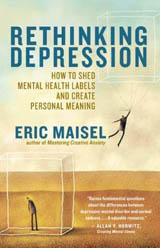
"Rethinking Depression" by Eric Maisel
“In Defense of Food: An Eater’s Manifesto,” the 2008 bestseller by Michael Pollan challenged us to take back our food supply from the “Nutritional Industrial Complex.”

Another bestselling author, Eric Maisel, psychologist and international creativity expert, in “Rethinking Depression: How to Shed Mental Health Labels and Create Personal Meaning,” urges us “make meaning” in order to take back our mood supply from the Medical Industrial Complex. [my coined phrase, not Maisel’s] 

Maisel encourages us to make a meaningful life in order to combat inevitable human unhappiness, then he tells us how. 

If this book hasn't been on the bestseller list by the time you read this review, I wish it were. It looks at life with an honesty and clarity that is rare, and much needed.

I am fortunate to be among a handful of artists, authors, and others across the globe to be asked to read and respond to "Rethinking Depression" as part of Eric Maisel's blog tour for it's launch this month.

Based on its title, at this point in my life I probably wouldn't have selected "Rethinking Depression" from a bookstore's shelves as my next read, but I'm extremely grateful to have read it.  It's true that you can't judge a book by its cover.  It arrived at just the right time to repeatedly provided insight that I'm on the right path, for me, as I work to make a meaningful life. I saw reflected back to me among its pages a philosophy and approach that rings true.

Maisel writes of his 2012 release with New World Library“I question whether ‘the mental disorder of depression’ exists or whether in contemporary times human sadness has been monetized and languaged into a ‘mental disorder.’ I follow that discussion with a plan for minimizing sadness and living life with purpose.” 

It is a book in two parts.

PART ONE: Maisel Rethinks Depression
Part One is a well-reasoned look at the medicalization and pathologization of common human experiences of emotional pain and sadness by the pharmaceutical industry and mental health establishment.  Maisel describes how our perception of these behaviors and experiences has been transformed by diagnostic lists of symptoms with an accompanying menu of approved treatments.

I find Maisel’s carefully reasoned arguments to be extremely persuasive. 

Though my reading of “Rethinking Depression”s opening chapters brought to mind many questions—I’m always one to ask, “Yeah, but what about…”—I was moved to speak aloud, “Yes!” when Maisel recommended that instead of the term “depression,” we use more specific and compassionate words such as “sadness” or “loneliness” or “disappointment” or “loss.”  These feelings are not medical conditions. They are normal human reactions to life’s harshest realities.  I won't be addressing those questions or their answers here, but in the course of writing this review I had the opportunity to interact with Eric Maisel directly. I will just say that this book represents only a small portion of a well-reasoned and compassionate conceptual edifice well worth exploring.

And there is great power in naming things as they truly are.

This is not to say that Maisel opposes prescription medication, talk therapy, or even religious practice as help for those struggling with difficult experiences and emotions. He simply wants us to recognize that these options are only that, options.

PART TWO:  We Learn to Rethink Depression
In Part Two of “Rethinking Depression”, Maisel presents another option: the reader can learn to "make meaning" by developing and acting on an "Existential Plan.”

Chapter 4, the first in Part Two, is one of the most beautifully stated explanations of a philosophical perspective—in this case existentialism—I have ever read.  With his customary pragmatic, conversational tone, Maisel lays out the ideas of Dostoyevsky, Nietzsche, Kafka, Sartre, and Camus in terms anyone can understand. Then he shows the reader how to move beyond the philosophical into the day-to-day application of these ideas to life.

To paraphrase: Life is both beautiful and extremely harsh.  No one can tell you what it all means. You have to take responsibility for yourself, decide for yourself what meaning you wish to make of life, then do your best each day to live ethically according to your own self-knowledge, values, and goals.  Even knowing that you will fall short of this ideal much of the time, Maisel asserts that this is the best way to deal with your own human unhappiness, simply by seeing life for what it is, being true to yourself, doing what you can and making what you can of your life as you go along.

For other more academic explanations of existentialism offering greater detail than I'm able, you might want to look at the following:
http://plato.stanford.edu/entries/existentialism/
http://en.wikipedia.org/wiki/Existentialism

Here is Jean-Paul Sartre's (b. 1908, d. 1980) own explanation of existentialism given in a lecture in 1949, if you care to wade through it:  http://www.marxists.org/reference/archive/sartre/works/exist/sartre.htm

The last time I’d tried to understand existentialism was in college. I attempted to read something by Sartre, perhaps "Being and Nothingness," on the recommendation of a friend, who I later learned had selectively adopted its ideas to justify an assortment of amoral life choices.

All I remember is that it left me feeling deeply depressed—or I should say profoundly unhappy and hopeless.  My father was dieing of cancer at the time.  My dreams for myself were proving to be much more difficult that I’d expected to make real, if not impossible, under the circumstances.  And I was experiencing my first crisis of faith, as the religious beliefs I was raised with longer seemed to ring true.  Sartre’s writing echoed my own dawning awareness of life’s harsh realities, without offering any comfort, at least in its opening pages.  It was too much for me at the time.

I wish someone had placed a copy of “Rethinking Depression” in the hands of my younger self all those years ago. Though, having read this book, I now feel as if someone has.

Part Two of this book begins with the realism of existential philosophy in Chapter 4, then fleshes out an approach to life that puts the power back into our hands as we each decide for ourselves how to be true to ourselves (live an authentic life) and make that life meaningful, even—perhaps, especially—when life seems most meaningless.

MAKING MEANING AND LIVING AN AUTHENTIC LIFE
In each of the chapters that follow, Maisel offers step-by-step guidance on how to do this, all the while admitting that meaning making, though worth the effort, is anything but easy.

I’m a big fan Do-It-Yourself.  I grow a garden each summer so my family, friends, and I can enjoy healthy fruits and vegetables. I bake my own bread by hand, from scratch, and even sew my own clothes when I have the time.  I entertain myself and perhaps offer the same to a few other people by creating original artwork and music from the raw materials of my imagination. And I volunteer for the causes I value most in the belief that making the world a better place is the ultimate DIY project.

Until I read “Rethinking Depression” that I had never thought to use the particular words “making meaning” to describe my DIY life. Now I realize  that’s exactly what I’ve always felt.  For me, Maisel’s use of that powerful phrase delivered a fabulous AH-HA moment, one of many provided by this book.

Maisel’s admonition to “focus on meaning, not mood” was another lightbulb moment for me. Again, this is something I attempt to do, though, for me, having the right words for it brings the practice to a higher level of awareness and choice.  In the face of life’s unavoidable unwanted experiences—and the pain, sadness, disappointment, and anger that inevitably accompanies them—I can choose in each moment to bravely, though imperfectly, turn my attention and actions toward the things I value most, toward creating the life and being the person I most wish to be.

Serendipitously, as I was writing this review, I happened to be working my way back through my personal journals from last summer, looking for bits of insight and lessons learned. After reading “Rethinking Depression,” I read the words I’d written then in a new way. 

I was taking the unavoidable difficulties of life and transforming them through choice and action into meaning.  In this way, I was able in the course of three handwritten pages to move from sadness to strength. I wrote:
I’m still feeling down this morning. What I imagine I’ve lost in the past 10 years is the optimistic boldness of belief that everything would work out as I imagined it would.  Time and again, I’ve faced emotional and physical setbacks that stripped me of my momentum….10 years ago I had no idea that all of this lay ahead.  All I saw was possibility.  I saw my own potential.  I believed that possibility and ability would come together to create the reality I envisioned.  If it were entirely up to me, then that’s exactly what would have happened.  It’s not.  It’s not entirely up to me.  My past, my body, the people I encounter and the things they choose to do, these are outside of my control.  They are the other creative forces.

All I can do is continue to show up.  When I’m tired, when I’m sad, when I’m so discouraged I want to give up, I can still show up.  I don’t have to feel it in order to continue acting on my creative vision. I start with what is, in this moment, and put my hand to it, apply my mind and emotion to it.  Even in sadness.  Even in despair of ever seeing my vision realized.

I am here.
As long as I am here there is hope for what might be.
That is enough.
I've learned along the way that life's obstacles and distractions offer some of the most meaningful adventures, as long as we can learn to walk through the unhappiness of unexpected detours and actively turn them into opportunities for learning and growth. Maisel's latest provides us with the tools and instructions we need to do this for ourselves.

"Rethinking Depression" should be required reading in the great school of living. We are each far more than a set of mental health criteria. We are far more than a diagnosis or the lack of one. Making a meaningful life is simply the best way to take back our mood supply.



ABOUT THE AUTHOR OF RETHINKING DEPRESSION


Eric Maisel, PhD, is a licensed psychotherapist and the author of Rethinking Depression and numerous other titles including Mastering Creative Anxiety, Brainstorm, Coaching the Artist Within, and A Writer’s San Francisco. He blogs for the Huffington Post and writes for Professional Artist Magazine. Visit him online at http://www.ericmaisel.com


RETHINKING DEPRESSION by Eric Maisel
February 15, 2012 •  Pychology/Personal Growth •  256 pages • Trade Paperback
Price: $14.95 • ISBN 978-1-60868-020-7


Saturday, June 05, 2010

BOOKS: Library Used Book Sale 2010

Today was the first day of our local library's used book sale, something I look forward to all year long. I brought home an armload to fill mind and heart in the coming months. They're stacking up my red reading chair where I'll spend this evening browsing through them, building anticipation for future evenings spent absorbed in their contents.

My most treasured purchase this year? (Pictured R, above)
Other fun and interesting finds (stack, above, top to bottom):
I still have a stack of reading material remaining from last year's sale, so I considered not going this year as a way to economize. Then convinced myself it would be good to find gift books for others, for birthdays and Christmas.

Did that.

But also brought home these additional "gifts" for myself. Averaging less than $2 each, they really weren't such an extravagance. Each is an affordable source of hours of entertainment and education.

I can think of worse weaknesses.

Friday, November 13, 2009

ECO ACTION: An American Eco-Radical?

Last month, my friend, Catherine, from New Zealand responded to my blog post about my decision to start air drying more of my clothes by saying:
  • "No criticism of you intended, but I'm always amazed at the things we think are normal in New Zealand that seem eco-radical to Americans!"
Eco-radical?

I don't think I've ever framed my choices as "eco-radical", but perhaps they're coming across that way. It's taken me a month since my last post to find a reasoned way to explain.

Let me clarify.

I realize that most of the world, by choice or circumstance, lives in a way that has far less environmental impact than the "American" lifestyle. We are the world's largest consumers of resources. We have greatest per-capita responsibility for greenhouse gases, pollution, and waste on the planet. And while I'm proud of my country and it's people for many different reasons, THIS is not one of them.

The ECO ACTION blog posts I write here are simply accounts of my efforts to reverse old habits in my own life--habits shared by most Americans--that unnecessarily consume precious resources and adversely impact our environment without, in my opinion, improving anyone's quality of life in a way that justifies the environmental costs.

That's it.

Personal change. Not eco-radicalism, unless you want to call it that.

I visualize an Eco-Radical as someone who lives entirely off the grid AND actively draws attention to themselves in the manner of Green Peace. These are the mavens of the environmental movement. Mavens provide a nexus for change. At one extreme end of the continuum, they showing us what is possible with extreme commitment and effort. Important, but rare.

I'm radical only in the sense that I'm swimming upstream within my own culture, a culture largely shaped by corporate advertising over the past 60-70 years.

Fortunately, the numbers of those swimming in the same contrary direction is steadily increasing.

My parents came of age in Southern California of the 1940's and 50's when science and capitalism (also incorrectly equated with democracy) promised to solve the problems of generations past--disease, poverty, hunger, long work hours, little opportunity, housing insecurity, over population, tyranny, etc.--along with their own.

Advertising in magazines, on TV, billboards, etc. showed smiling families with shiny new washers and dryers, bigger cars, convenience foods, ... and an ever increasing standard of living for them or their children. More free time, large private homes with big green lawns and shady trees, safe streets where children could play, greater health and longer lives...more possessions and more time to enjoy them, that was the promise. Science would solve any unforeseen negative consequences of all this progress, just as it had everything else.

We believed it. And, largely, that promise was delivered for white middle class America. Not without negative consequences. And not fulfilled equally across racial groups, geographical regions, or economic groups.

I'm all for greater food and housing security, living without fear of violence or disease, and having enough free time to fulfill ones intellectual and spiritual potential--but our American consumer culture doesn't focus on these essentials. It's all about a search for happiness in the stuff.

I heard recently that if everyone on the planet lived the American lifestyle, the one we're trying to sell to them, we would need 6 planet earths to support the current population.

We are a country with a frontier mentality. It's an indelible part of our national identity.

During the first 300 years of our history we learned to expand our borders, expand our manufacturing and agricultural production capacity, expand our population and personal wealth. We came to believe that limitless expansion was a divine right, one granted to us by "our" God as a reward for our form of government and our "Christian" society that pleased the Creator.

How often in advertising do we hear phrases reinforcing the "right" to "buy the best" because we "deserve it." The premise is that we "work hard" and we are "good people," so we deserve all the things we can buy.

There are those who continue to believe that science will save us in the end from all the negative consequences of our limitless consumption, that we can continue on this same path without worry.

Or that environmental conditions really aren't so bad; the concept of global warming and irreversible depletion of resources is a conspiracy concocted by a atheistic scientists to frighten us.

Or that this earth is only our temporary home before we're taken up to heaven, so we shouldn't concern ourselves with its problems.

While I don't consider myself an "eco-radical", my experiences of this culture are somewhat that of an outsider.

When I was growing up my parents subscribed to "Organic Gardening" magazine. I read it from cover to cover. They grew and preserved most of the fruits and vegetables we ate in a garden and orchard irrigated in part with "gray water" from the washing machine where my mother used biodegradable soaps, and fertilized with our own composted food scraps and yard waste. They did this not so much for environmental reasons, but because they were both children during the Great Depression. For the same reason they bought nothing on credit including their house and car, they saved a large portion of my father's income for retirement, and most of our clothes were homemade.

But this was far from the norm in suburban Southern California.

My own environmental awareness began when, in 1970's Southern California, there were many days I couldn't go outside to play. The smog generated by suburban sprawl, power plants and manufacturing was so bad that my lungs ached when I did more than sit quietly on the floor. And I was a healthy child, not one with asthma or allergies. I learned from our monthly National Geographic magazines that this sort of thing was happening all around the world, and had been for decades.

I remember when they outlawed leaded gas and worked to make stricter auto emissions standards. And the air began to clear. I remember hearing about "Love Canal", and "Silent Spring", and the clean-up of Boston Harbor. At that time, when the movement to start recycling our bottles and cans was in it's infancy, manufacturers complained that it would cost too much and they'd have to pass the increased costs along to consumers. The usual threat. Voters had the courage to pass the recycling bill in California anyway.

And I remember the first Earth Day. And the hope I felt for the future.

So, yes, our family has a washer and dryer, a dishwasher and other modern "conveniences"; two cars (though both about 10 years old); a house with a big green lawn and shady trees; safe streets where our children played; more free time, better health care and longer lives than my great-grandparents could expect...more possessions and more time to enjoy them.

But what shall I do with all this? Shall I continue to buy and waste and consume because that's what my culture says is OK, because they say it is my "right" to do so? Should I feel guilty about all this.

Or should I begin to change what I can. Use less. Consume less. Buy less. Enjoy the simple things and relationships with people more.

The things things we have are blessings, not rights. When the founders of this country were talking about our rights the pursuit of unlimited consumer goods is not what they meant by "the pursuit of happiness". But that's another discussion.

If this sort of thinking makes me an eco-radical, then go ahead and label me as such. But only within the context of my own culture. A culture that is desperately in need of change, for the good of all.

And to my New Zealand friend, though you "certainly don't worry about whether [your] undergarments are 'suitable' for drying outside", I will continue to hide mine away from view. Would you hang out your undergarments where your boss or customers could see them? This is not only my home, but also my place of business. I'm not eager to subject my students, their parents, or my recording clients to such a sight. And I'm certain they would agree.

Saturday, June 13, 2009

BOOKS: Library Sale Re-Re-Revisited

Bibliophile's Bounty: For $5 and a Brown Paper Bag

I'm 'fessin' up.  I've been to the library book sale four times this week.

I went the first time last Saturday, on the initial day of the sale and came home with an armload of books.  Then again on Monday because I thought everything was half-off, but it wasn't.  And again yesterday, Friday, because everything really was half-off.

Finally, I stopped in today for the final day $5 fill-a-paper-grocery-bag-full-of-books sale.

I fit all of the following (plus some books to give not listed here) inside the brown paper grocery bag I was given a the door.  In no particular order:

COOKBOOKS
MISC Non-Fiction and Reference
CHILDREN'S
Not bad for $5.

The books I bought half-price yesterday will mostly end up as gifts for other people, but for my studio library I found "American Folk Songs for Children," by Ruth Crawford Seeger 1948.  It's The original hardcover edition, filled with traditional songs and accompanying activities.  I sat at the piano yesterday evening for quite a while playing and singing my way through it.

Thanks to my four trips to the book sale this week the "Friends of the Mystic & Noank Library" are about $50 richer.  With cutbacks to the CT State budget funding for libraries this year, I'm sure it will be put to good use.

And I have a wealth of reading material, some 60 or more new-to-me volumes to savour and share.

Tuesday, June 09, 2009

BOOKS: Library Sale Revisited

Thinking that everything was half price all week at the library's used book sale, I went again yesterday and loaded my arms with an interesting assortment of volumes.

When I reached the front table to pay and discovered that the 50% off prices wouldn't kick in until Thursday and Friday, I didn't have the strength to return my selections to the jumbled piles where I might never see them again.  Once in my arms I couldn't release them.

"It's for a good cause," the volunteer at the check-out table assured me, smiling.

So here's what followed me home yesterday:
Not saying how much I spend.  It was less than $20, but still I'm a little embarrassed.

I suppose I shouldn't be--it was far less even than if I'd purchased them used on Amazon.  I stayed within the budget I'd set for myself in anticipation of this annual opportunity to stock up on reading material.

I'll admit it.  I'm a book addict.  I'll probably go back for the $5 bag-full-o-books sale on Saturday.

In the meantime I've got to find space on our shelves.

Saturday, May 23, 2009

ECO ACTION: 2nd Farm Share & More Tag Saling

I'm a big fan of abundance on a shoestring.
Another armload of gorgeous vegetables today from Studio Farm.

I didn't make it to the farmers market to pick them up.  I thought the market was 10-1 today as it had been during the winter.  Spring and summer hours are actually 9-Noon.  Also, I'd stopped at every tag sale along the way between home and the market.  When I arrived the park was empty.

So, I arranged to go out to the Stonyledge Farm this afternoon to pick them up instead.  I was greeted by several happy free-range chickens as I got out of the car.  Belinda and Ed were very accommodating.

This week's CSA half-share included (photo above, clockwise from top left): a very large head of tatsoi, a generous helping of mustard greens, 2 heads of kale (I think), chard, 3 small heads of loose-leaf lettuce (red and green), spinach, a bunch of fragrant mint, chives, mixed greens with flowers, half-dozen very large eggs, and several long rhubarb stalks.

And the fate of last week's veggies was as follows:
  • Tatsoi stir fry with garlic scapes, onions, sesame oil, brown basmati rice, scrambled egg, and 5 chinese seasoning.
  • Eggs: used 2 in stir fry, 2 in tapioca pudding, and 2 hard boiled.  They turned the tapioca pudding a wonderful shade of yellow that just can't be matched by grocery store eggs.
  • Spinach, kale (or was that mustard greens?), and broccoli rabe all steamed and eaten.
  • Lettuce used for several salads, shredded for black bean burritos, and in sandwiches
All delicious!

As of this morning, I only had a little lettuce, a few garlic scapes, the 2 hard boiled eggs, and some rhubarb remaining.  Because it was so fresh when brought home last Saturday the lettuce is none the worse for a spending a week in the refrigerator.  Much, much better than store bought.  The remaining lettuce and eggs will become a salad for dinner this evening, with rhubarb crisp for dessert.

In spite of the doubts I expressed last Saturday we ate our way through the vegetables quite easily. If I hadn't gotten involved in a project, lost track of time, and ended up skipping lunch a couple of times this week we would have completely emptied the vegetable drawer in time for today's pick up.

One of the reasons I signed up for this CSA (Community Supported Agriculture) farm share was to learn.

I wanted to learn about new foods, new ways of cooking familiar foods, new insights for my own garden, and to experience the feeling of enjoying an abundance of fresh healthy food on a regular basis.

I wouldn't have chosen to put all these greens in my grocery cart if I'd been buying them at the super market, but I've learned that what looked like a lot of fresh spinach and kale turned out to be just enough to accompany several meals when steamed.

Just right, not too much.

Tatsoi stir fry was also a first for me and it turned out great.  I wouldn't have taken a chance on this at the grocery store, not knowing in advance what it would taste like or how to cook it.  At the farmer's market, though, Dot Wingate gave me simple verbal instructions for cooking it when I picked up my share.  It couldn't have been easier or tastier.

I figure that nature has a wisdom of its own.  The abundance of fresh greens available in spring is probably just what our bodies need to restore themselves at the end of winter and get ready for summer's active season.  These greens were loaded with flavor and probably lots of good healthy stuff never find on a food label.

I know that I can't remember ever feeling healthier.  Looking forward to more.
__________________________________________________

Here are this weekend's fabulous tag sale finds (photo above, clockwise from top left):

For a GRAND TOTAL of $27
  • 3 variagated solomon's seal plants
  • 7 antique hand-painted china dessert plates, signed by a (locally) well-known local artist
  • 8 Books: "Lectures and Biographical Sketches" by Ralph Waldo Emerson, "The Complete Poetical Works of John Greenleaf Whittier," "Little Songs of Long Ago", "Drawing with the Right Side of the Brain," "A Whack on the Side of the Head: How You Can Be More Creative" by Roger von Oech, "Good Housekeeping Illustrated Cookbook" (to give), "The Food-Lover's Garden," "Neal's Yard Natural Remedies"
  • A small, 1 page-per-day diary for writing down little daily happy things
  • 2 pocket charts (teaching tools)
  • Kitchen Stuff: a pastry knife, a blue-green resealable glass jar, a garlic press (actually I'll use this for extruding clay, not garlic), a cookie press, AND a sturdy 10 inch cast-iron skillet--I'd been looking for one for a long time (favorite find of the day).
  • Misc: 1 new package of binder tabs, 2 new plastic pocket folders, an awl, a very basic digital camera with cable and software (tested and works on PC), two pair small sharp scissors (I keep losing my nail scissor, not good for one who plays piano and works with clay), an artist's paintbrush, a small hot plate, two colorful coin purses, a set of magnetic words (for songwriting play), and 9 new tennis balls (to turn into teaching toys).
Here's close-up of the hand-painted china plates.
Do I really need any of this?  Probably not.  Is it truly frugal to buy things I don't need?  Again, no.

On the other hand, these things will be used and enjoyed.  No additional resources were consumed to make them.  Each piece has a story and a connection to others.  I'm giving a good home to things that others no longer wanted, like bringing home abandoned puppies.

And I had a good time in the process.  I like the experiencing of happening upon things unexpectedly.  I like the feeling of discovery.

Now, I probably need to go through our house and liberate a few of my unused possessions so they can move on to homes where they'll be appreciated.

Tuesday, May 19, 2009

RECIPE: Apple Crisp

If you're worried about the health effects of butter and sugar, then this isn't the recipe for you.  Personally, I consider them to be essential parts of a well balanced diet.

The apples that provided the impetus to creating this recipe were the last of our locally grown apples from the farmers market, kept in storage in their basement since last fall.  Not great for fresh eating, but perfect for baking.

Another Kay's Kreative Kitchen original.*

FOR THE FILLING:
  • 6 c apples**, cored and sliced with skin on (variety of your choosing)
  • 1/2 c sugar (I used 1 cup per another recipe and it seemed a bit too sweet)
  • 2 Tbs flour
  • 1/2 tsp cinnamon
  • 1/4 tsp nutmeg
  • 2 Tbs fresh lemon juice
Wisk together sugar, flour, cinnamon, and nutmeg in a large bowl.  Toss with apples to coat and pour into a 2-quart glass baking dish. [I used my "new" 10-inch round pyrex pie plate ] Sprinkle lemon juice over apple mixture.

Optional: sprinkle mini-chocolate chips over the apples in the dish.

FOR THE TOPPING:
  • 1 cup all purpose flour (I use unbleached)
  • 3/4 c quick or old-fashioned rolled oats
  • 1/2 c packed light brown sugar
  • 1/2 c (1 stick) cold butter, cut into 1/4 inch pieces
  • 3/4 tsp ground cinnamon
In the same large bowl used above, combine flour, oats, brown sugar, butter and cinnamon.  Mix with hands until coarse crumbs form.  Spread over apple filling in baking dish.

If you anticipate that the crisp may bubble over while baking, place the baking dish in the middle of a large cookie sheet before placing in the oven.  Bake about 40 minutes at 400F, rack in middle position, until filling bubbly and topping is golden brown.  Allow to cool slightly before eating.

*Ingredients and methods were re-combined from recipes found in: "The Lily Wallace New American Cook Book", 1943; "Better Homes and Gardens: New Cook Book", 1962; "Good Housekeeping: 100 Best Dessert Recipes", 2004.  The addition of chocolate chips and lemon juice were entirely my own idea.

(c)2009 Kay Pere ~ Effusive Muse Publishing

Sunday, May 17, 2009

ECO ACTION: First CSA Share & Tag Sale Finds

I got to pick up my first ever CSA (Community Supported Agriculture) share at the Stonington Farmers Market yesterday morning.  Garden Girl and Eco Action Girl (two of my secret super hero identities) have both been extremely happy with anticipation all week, looking forward to the prospect of bringing home an armload of fresh, locally grown, certified organic spring veggies.

In my first spring half-share from Studio Farm I received:

PHOTO ABOVE: (clockwise from top left) spinach, half-dozen eggs, kale, butter crunch lettuce, broccoli rabe, red oakleaf lettuce, and another butter crunch.

PHOTO BELOW: (left to right) tatsoi, garlic scapes, rhubarb

Aren't they gorgeous?!

Thank you, Belinda, for the care you put into growing them.  They will be savored.

As a point of reference for size, for these photos the produce was spread over two regular-size kitchen towels placed side-by-side.

It's certain that in the week ahead I'll be abiding by Michael Pollan's admonition--from his book, "In Defense of Food"--to:

"Eat food.* Not too much.  Mostly plants."

*[as opposed to manufactured foodlike substances]

Though I'm not so sure about the "not too much" part.  That's a lot of greens for two people to consume in one week, especially when  the other in this house would gladly choose frozen peas from the grocery store over all other vegetables.

If next week's share arrives before they've made their way to the table, the spinach and kale will  be blanched and frozen.   That's the plan.  I like the idea that a bit of spring greenery can be saved up in the freezer to combat next winter's doldrums.

------------------------------------------------------------------------
Not only is this the season for the first fresh locally grown veggies , it's also Tag Sale Season!

Here's this week's haul:
This week's treasures include: (counter clockwise from top left) a cranberry colored pyrex pie plate (for rhubarb crisp?), a 4-quart cast iron and enamel dutch oven, 3 blue stripped cotton dinner napkins, a glass citrus juicer, and a compact cassette player/recorder.

All were in new or nearly new condition.  Total for all: $25, which will go toward the community work of a local church.  

The price of the dutch oven was the majority of this total at $20, though it would have cost $70 or more even in a store like Target or Walmart.  I've been eyeing them for months now, but holding off for a special occasion.  Happy Birthday to me!

The cloth dinner napkins are part of my effort to reduce the use of disposables in our household.  I keep a stack handy near the kitchen table.  I've been air drying them after washing in cold water to minimize the energy consumed for keeping them clean.

The $1 cassette player/recorder is a gift for one of my student's who has no way to play back recordings of her voice lessons for practice at home.  It would have cost about $22 at Walmart, if you can still find them there.

I'm looking forward to next weekend already.  More fresh veggies and eggs, and Memorial Day weekend is always the biggest tag sale weekend of the entire year around here.  You never know what you'll find.

Looking forward to all the good cooking and eating in the week ahead.

Monday, December 01, 2008

QUOTES: "Miracles" from "Leaves of Grass"

WHAT shall I give? and which are my miracles?

Realism is mine—my miracles—Take freely,
Take without end—I offer them to you wherever your
feet can carry you, or your eyes reach.

Why! who makes much of a miracle?
As to me, I know of nothing else but miracles,
Whether I walk the streets of Manhattan,
Or dart my sight over the roofs of houses toward the
sky,
Or wade with naked feet along the beach, just in the
edge of the water,
Or stand under trees in the woods,
Or talk by day with any one I love—or sleep in the
bed at night with any one I love,
Or sit at the table at dinner with my mother,
Or look at strangers opposite me riding in the car,
Or watch honey-bees busy around the hive, of a sum-
mer forenoon,
Or animals feeding in the fields,
Or birds—or the wonderfulness of insects in the air,
Or the wonderfulness of the sun-down—or of stars
shining so quiet and bright,
Or the exquisite, delicate, thin curve of the new-moon
in spring;

To me, every hour of the light and dark is a miracle,
Every inch of space is a miracle,
Every square yard of the surface of the earth is spread
with the same,
Every cubic foot of the interior swarms with the same;
Every spear of grass—the frames, limbs, organs, of
men and women, and all that concerns them,
All these to me are unspeakably perfect miracles.

~ Walt Whitman, from Leaves of Grass, 1867 edition
[excerpted, read the poem in its entirety HERE]

Saturday, October 04, 2008

QUOTES: "To say that she had a book..."

"To say that she had a book is to say that her solitude did not press upon her; for her love of knowledge had a fertilising quality and her imagination was strong."
~ Henry James, "The Portrait of a Lady", Chapter III (1881)

Saturday, June 14, 2008

BOOKS: Library Sale

I love books.  Especially good used books that can be had for next to nothing.

This was the week of the annual book sale at our local library.  For far less than one might spend on a single, new, hard-cover book, I brought home 17 barely-used, new-to-me books:

COOKBOOKS
GARDEN AND HERB LORE
OTHER
ADDITIONAL READING

Also, last Saturday at our great big yard sale, I rescued a copy of "The Wind in the Willows,"by Kenneth Graham, from one of the boxes of kids books we had for sale.  I'd never read it as a child, so I started on it while sitting in the shade during lulls in business that day.  Just finished it yesterday afternoon.

I was surprised by the  poetry of the prose and the sophistication of the vocabulary used in a book intended for children.  It was first published in 1908.  It's heartening to think of the respect given to the intellect of children in a book such as this, discouraging when compare with the mindless entertainment provided for children by today's media.

Today I just returned borrowed library copies of "Northanger Abbey"* and "Persuasion"* by Jane Austin.  I'm in the process of reading through her works, for the first time, this spring and summer.  Read "Emma"* a few weeks ago.  Have checked out "Mansfield Park"* to begin this week.

[*Skip over plot summaries in these links if you don't want to spoil reading the novels for yourself.]

Though Jane Austin's books were written nearly 200 years ago, the characters described within their pages demonstrate that human nature has changed little over the last two centuries, if at all.

In this light, I'm able to view my own encounters with difficult characters less as a matter of personal bad luck and more as the inevitable result of living and interacting with others.

(c)2008 Kay Pere ~ Effusive Muse Publishing