Showing posts with label creativity. Show all posts

Tuesday, November 24, 2015

Meaning Basket for a Mindful Holiday Season

We've put up our Christmas tree early this year, two full weeks before Thanksgiving. The plan is to decorate it during the November calm so we'll be able to enjoy it even while busy with rehearsals and preparations for the annual LUNCH Holiday Show next week, and tired week that follows, when we'll be putting away mountains of scenery, props, and costumes.


With all that's been in the news lately, I've been especially aware of the gulf between the attitudes of Thanksgiving, love, community, and gratitude this holiday is meant to represent--with it's intended mindfulness of others' needs--and the actual Season of Consumerism and over-consumption that follows instead. I know I sound like a bit of a Scrooge, but personally I don't need any more things, or hobbies, or toys for entertaining myself. I have much more of everything already, and I suspect that most of the people I know are in this same situation. Our planet doesn't need the impact of manufacturing all this, transporting or storing it. I'm aware of my own excess, but at a loss to know what to do to help the many, many people in this world who have far less than they need for basic survival and comfort.

With all this in mind, I've decided to make a small change in the way I approach the coming season. In effort to change my holiday habits of over-doing, over-wanting, and over-buying, I've created a different sort of symbolic container to place beneath our Christmas tree. It's a second-hand basket--a Meaning Basket--to contain my growing awareness of all the good that already exists in my life, as well as tangible reminders of the material, hopeful, and helpful longings I feel.

To this end, I've cut small pieces of scrap printer paper from the recycling bin, gathered a handful of pencils, and placed these together in convenient places all around our house.  On the slips of scrap paper, As I think of them I'll write the names of the many people, things and opportunities I already have in my life, then I"ll drop these into the Meaning Basket under our Christmas tree. (The piles of paper scraps and pencils all over the house are something I've been using for a long time to capture creative ideas and reminders for my TO-DO list.)


I'll focus, especially, on those people and things I never seem to get around to enjoying as fully as I would like. Then, I'll take steps to do the special things I always intend to do, but never seem to get around to because I'm too busy with shopping, rushing around, or looking through the mountains of holiday catalogs that come in the mail each day. As for my unused possessions, I'm either going to make a point put those things to good use in the coming year or give them to someone else who will. How many of these are things I've asked for and received for Christmas in the past?!

I'll also write down the needs I see in our community, the many things I see and feel drawn to help with. There are so many that I often feel pulled in all directions, overwhelmed, with no plan of action. In January, as I'm looking ahead to the coming year, I'll sort these out and choose something to follow through with, something tangible and manageable to make a start.

Our close family has asked to keep gift exchange simple this year with primarily homemade, handmade gifts, gift cards, and time spent spent enjoying each other's company. This feels right to me.

Mindful of this, I intend to use the basket and scraps of paper instead of spending December thinking about what else I might want and don't really need, or wandering through stores and shopping online trying to figure out what to get for people who've told me they don't really need anything else either. When I see an ad for something I might want, I'll get the scissors and cut out a picture of it, like I did when I was a kid, then drop that picture into the basket where it can sit in the context of all the good that already exists in my life. Thus, my inevitable longings for shiny, new things will find more balanced context, a context where I can better decide which acquisitive longings to indulge.


All this may be asking a lot of a second-hand basket, but such a simple container seems like an appropriate symbol for carrying the Thanksgiving mindset of gratitude and mindfulness forward into the coming Christmas season. It is my hope that the value of my new Meaning Basket and the insights it holds will stay in place long after our Christmas tree has been put away.

Will you join me by filling your own Meaning Basket this season?

©Kay Pere ~ Effusive Muse Publishing

Sunday, November 22, 2015

20151120 Happiness = New Words + New Melody

Happiness is listening to the radio on a long drive home after a satisfying day of work, with a beautiful, pink-clouded sunset filling the sky all around me.


Happiness is finding a program on the radio playing songs Stephen Sondheim said he wished he'd written. Among the selections was one I'd never heard before, a lump-in-the-throat-joyful-AHA-moment-feeling-at-the-end sort of song, written for a voice just like mine.

Happiness is coming home to discovering that I already have the sheet music for this song among the books on the shelves in my studio.

Happiness is setting a goal to learn to sing and play the song this week. I will sing it for others sometime soon, in the hope of giving them that same lump-in-the-throat-joyful-AHA-moment sort of feeling it gave to me :-)

New Words, new melody. This is happiness.

I'm not going to come right out and tell what the song is. Not yet. Though there is a big fat clue among the words you've just read.

And here is another big clue.


©Kay Pere ~ Effusive Muse Publishing

Sunday, April 29, 2012

Eric Maisel Does For Mood What Michael Pollan Did For Food


MY REVIEW AND RESPONSE TO 
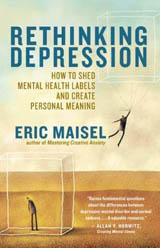
"Rethinking Depression" by Eric Maisel

“In Defense of Food: An Eater’s Manifesto,” the 2008 bestseller by Michael Pollan challenged us to take back our food supply from the “Nutritional Industrial Complex.”

Another bestselling author, Eric Maisel, psychologist and international creativity expert, in “Rethinking Depression: How to Shed Mental Health Labels and Create Personal Meaning,” urges us “make meaning” in order to take back our mood supply from the Medical Industrial Complex. [my coined phrase, not Maisel’s] 

Maisel encourages us to make a meaningful life in order to combat inevitable human unhappiness, then he tells us how. 

If this book hasn't been on the bestseller list by the time you read this review, I wish it were. It looks at life with an honesty and clarity that is rare, and much needed.

I am fortunate to be among a handful of artists, authors, and others across the globe to be asked to read and respond to "Rethinking Depression" as part of Eric Maisel's blog tour for it's launch this month.

Based on its title, at this point in my life I probably wouldn't have selected "Rethinking Depression" from a bookstore's shelves as my next read, but I'm extremely grateful to have read it.  It's true that you can't judge a book by its cover.  It arrived at just the right time to repeatedly provided insight that I'm on the right path, for me, as I work to make a meaningful life. I saw reflected back to me among its pages a philosophy and approach that rings true.

Maisel writes of his 2012 release with New World Library, “I question whether ‘the mental disorder of depression’ exists or whether in contemporary times human sadness has been monetized and languaged into a ‘mental disorder.’ I follow that discussion with a plan for minimizing sadness and living life with purpose.” 

It is a book in two parts.

PART ONE: Maisel Rethinks Depression
Part One is a well-reasoned look at the medicalization and pathologization of common human experiences of emotional pain and sadness by the pharmaceutical industry and mental health establishment.  Maisel describes how our perception of these behaviors and experiences has been transformed by diagnostic lists of symptoms with an accompanying menu of approved treatments.

I find Maisel’s carefully reasoned arguments to be extremely persuasive. 

Though my reading of “Rethinking Depression”s opening chapters brought to mind many questions—I’m always one to ask, “Yeah, but what about…”—I was moved to speak aloud, “Yes!” when Maisel recommended that instead of the term “depression,” we use more specific and compassionate words such as “sadness” or “loneliness” or “disappointment” or “loss.”  These feelings are not medical conditions. They are normal human reactions to life’s harshest realities.  I won't be addressing those questions or their answers here, but in the course of writing this review I had the opportunity to interact with Eric Maisel directly. I will just say that this book represents only a small portion of a well-reasoned and compassionate conceptual edifice well worth exploring.

And there is great power in naming things as they truly are.

This is not to say that Maisel opposes prescription medication, talk therapy, or even religious practice as help for those struggling with difficult experiences and emotions. He simply wants us to recognize that these options are only that, options.

PART TWO:  We Learn to Rethink Depression
In Part Two of “Rethinking Depression”, Maisel presents another option: the reader can learn to "make meaning" by developing and acting on an "Existential Plan.”

Chapter 4, the first in Part Two, is one of the most beautifully stated explanations of a philosophical perspective—in this case existentialism—I have ever read.  With his customary pragmatic, conversational tone, Maisel lays out the ideas of Dostoyevsky, Nietzsche, Kafka, Sartre, and Camus in terms anyone can understand. Then he shows the reader how to move beyond the philosophical into the day-to-day application of these ideas to life.

To paraphrase: Life is both beautiful and extremely harsh.  No one can tell you what it all means. You have to take responsibility for yourself, decide for yourself what meaning you wish to make of life, then do your best each day to live ethically according to your own self-knowledge, values, and goals.  Even knowing that you will fall short of this ideal much of the time, Maisel asserts that this is the best way to deal with your own human unhappiness, simply by seeing life for what it is, being true to yourself, doing what you can and making what you can of your life as you go along.

For other more academic explanations of existentialism offering greater detail than I'm able, you might want to look at the following:
http://plato.stanford.edu/entries/existentialism/
http://en.wikipedia.org/wiki/Existentialism

Here is Jean-Paul Sartre's (b. 1908, d. 1980) own explanation of existentialism given in a lecture in 1949, if you care to wade through it:  http://www.marxists.org/reference/archive/sartre/works/exist/sartre.htm

The last time I’d tried to understand existentialism was in college. I attempted to read something by Sartre, perhaps "Being and Nothingness," on the recommendation of a friend, who I later learned had selectively adopted its ideas to justify an assortment of amoral life choices.

All I remember is that it left me feeling deeply depressed—or I should say profoundly unhappy and hopeless.  My father was dieing of cancer at the time.  My dreams for myself were proving to be much more difficult that I’d expected to make real, if not impossible, under the circumstances.  And I was experiencing my first crisis of faith, as the religious beliefs I was raised with longer seemed to ring true.  Sartre’s writing echoed my own dawning awareness of life’s harsh realities, without offering any comfort, at least in its opening pages.  It was too much for me at the time.

I wish someone had placed a copy of “Rethinking Depression” in the hands of my younger self all those years ago. Though, having read this book, I now feel as if someone has.

Part Two of this book begins with the realism of existential philosophy in Chapter 4, then fleshes out an approach to life that puts the power back into our hands as we each decide for ourselves how to be true to ourselves (live an authentic life) and make that life meaningful, even—perhaps, especially—when life seems most meaningless.

MAKING MEANING AND LIVING AN AUTHENTIC LIFE
In each of the chapters that follow, Maisel offers step-by-step guidance on how to do this, all the while admitting that meaning making, though worth the effort, is anything but easy.

I’m a big fan Do-It-Yourself.  I grow a garden each summer so my family, friends, and I can enjoy healthy fruits and vegetables. I bake my own bread by hand, from scratch, and even sew my own clothes when I have the time.  I entertain myself and perhaps offer the same to a few other people by creating original artwork and music from the raw materials of my imagination. And I volunteer for the causes I value most in the belief that making the world a better place is the ultimate DIY project.

Until I read “Rethinking Depression” that I had never thought to use the particular words “making meaning” to describe my DIY life. Now I realize  that’s exactly what I’ve always felt.  For me, Maisel’s use of that powerful phrase delivered a fabulous AH-HA moment, one of many provided by this book.

Maisel’s admonition to “focus on meaning, not mood” was another lightbulb moment for me. Again, this is something I attempt to do, though, for me, having the right words for it brings the practice to a higher level of awareness and choice.  In the face of life’s unavoidable unwanted experiences—and the pain, sadness, disappointment, and anger that inevitably accompanies them—I can choose in each moment to bravely, though imperfectly, turn my attention and actions toward the things I value most, toward creating the life and being the person I most wish to be.

Serendipitously, as I was writing this review, I happened to be working my way back through my personal journals from last summer, looking for bits of insight and lessons learned. After reading “Rethinking Depression,” I read the words I’d written then in a new way. 

I was taking the unavoidable difficulties of life and transforming them through choice and action into meaning.  In this way, I was able in the course of three handwritten pages to move from sadness to strength. I wrote:
I’m still feeling down this morning. What I imagine I’ve lost in the past 10 years is the optimistic boldness of belief that everything would work out as I imagined it would.  Time and again, I’ve faced emotional and physical setbacks that stripped me of my momentum….10 years ago I had no idea that all of this lay ahead.  All I saw was possibility.  I saw my own potential.  I believed that possibility and ability would come together to create the reality I envisioned.  If it were entirely up to me, then that’s exactly what would have happened.  It’s not.  It’s not entirely up to me.  My past, my body, the people I encounter and the things they choose to do, these are outside of my control.  They are the other creative forces.

All I can do is continue to show up.  When I’m tired, when I’m sad, when I’m so discouraged I want to give up, I can still show up.  I don’t have to feel it in order to continue acting on my creative vision. I start with what is, in this moment, and put my hand to it, apply my mind and emotion to it.  Even in sadness.  Even in despair of ever seeing my vision realized.

I am here.
As long as I am here there is hope for what might be.
That is enough.
I've learned along the way that life's obstacles and distractions offer some of the most meaningful adventures, as long as we can learn to walk through the unhappiness of unexpected detours and actively turn them into opportunities for learning and growth. Maisel's latest provides us with the tools and instructions we need to do this for ourselves.

"Rethinking Depression" should be required reading in the great school of living. We are each far more than a set of mental health criteria. We are far more than a diagnosis or the lack of one. Making a meaningful life is simply the best way to take back our mood supply.


ABOUT THE AUTHOR OF RETHINKING DEPRESSION


Eric Maisel, PhD, is a licensed psychotherapist and the author of Rethinking Depression and numerous other titles including Mastering Creative Anxiety, Brainstorm, Coaching the Artist Within, and A Writer’s San Francisco. He blogs for the Huffington Post and writes for Professional Artist Magazine. Visit him online at http://www.ericmaisel.com. 


RETHINKING DEPRESSION by Eric Maisel
February 15, 2012 •  Pychology/Personal Growth •  256 pages • Trade Paperback
Price: $14.95 • ISBN 978-1-60868-020-7


Tuesday, April 26, 2011

FREE DOWNLOAD: Grand Design: Artist's Prayer MINI-POSTER

FREE PDFs to DOWNLOAD*

Formatted for 8x11 inch paper. Looks particularly yummy printed on beige card stock. You will need Acrobat reader or some other program to view the PDFs. Print settings may have to be adjusted to accommodate the size of the image within the allowable margins of your printer.

WHAT IT SAYS
The Grand Design: An Artist's Prayer
a song by Kay Pere

My heart is a parchment, my hand holds a quill.
I dip this pen, quivering, afraid the ink might spill.
I long to draw you to me, Great Mystery within.
Move my hands, move my heart, guide my pen.

Though I try to sketch the future, only your hand turns the page.
You erase the stains and smudges of my past mistakes.
So I ask, please, grant the wisdom to know where to draw the line
And provide a clearer vision of your Grand Design.

I could never pen your portrait for I've yet to see your face,
But I know you from your likeness in the beauty of this place.
The pattern of your stillness rests upon my open book.
A still life of your spirit shines wherever I might look.

Though I try to sketch the future, only your hand turns the page.
You erase the stains and smudges of my past mistakes.
So I ask, please, grant the wisdom to know where to draw the line
And provide a clearer vision of your Grand Design.

Great Artist, you arranged the stars and fashioned each small flower.
My heart and hands are yours to move in the quiet of this hour.

So I ask, please, grant the wisdom to know where to draw the line
And provide a clearer vision of your Grand Design.

(c) Kay Pere ~ Effusive Muse Publishing

WHAT IT'S ABOUT
Sometimes, making a beginning is the hardest part, until you remember that you don't create alone.

I've always felt a bit intimidated by a blank piece of paper, an unplanted garden bed, an unshaped lump of clay, a song waiting to be recorded. No matter how many times I've done something before, successfully or not, beginning anew is always accompanied by a particular kind of internal resistance.

The outcomes of my efforts, past and future, draw themselves vividly before me in that moment when I sit down to begin. Sometimes this feels so daunting that find it hard not to turn away.

I wonder to myself: Will it work out as well as it did last time? Will the result be what I imagine? Or will I repeat my past mistakes? Will my weaknesses of skill, knowledge, character or body keep me from completing what I've set out to do? Will my work be blocked by something I can't foresee?

I lose hope.

Until I remember how many times that errors--both on the page and in my life--have lead to outcomes much better than I ever could have envisioned.

In life, my most painful and costly mistakes have always ushered in periods of the greatest personal growth. Mishaps and mistakes in judgment have taught compassion, forgiveness, resilience, strength, self-acceptance, and so much more.

In my creative work, I can't count the number of times a failure of materials, equipment, skill, or advice has brought me to a place where the things I'd originally set out to do were no longer possible. I'm learning to be more open to accepting change and seeing what IS possible. When I can to do this, the results I didn't expect are always more interesting and original than those I could have planned.

I know I haven't provided specific examples. In the coming days I hope it to write in more detail on my other blogs, sharing anecdotes from my pottery work, songwriting, and teaching. As soon as these interrelated essays are ready, I'll share links to them here.

I hope you'll print out a mini-poster or two, and place it where it can inspire you.

The words are meant as a reminder that there is another Artist who creates along side you.

Take chances, trusting that--one way or another--the outcome of your efforts will be something beautiful.

As we create, so we are created.

HOW THIS WAS MADE
The hand-drawn frame of this MINI-POSTER was doodled on the back of an old 8x10 glossy publicity photo I had taken and duplicated by the hundreds for a press kit about 8 years ago. I have a huge stack of these photos remaining, an error in planning I've been hiding in the top of my studio closet, but that's a story for another time. Now they're becoming the raw material for something much more satisfying, serving as sturdy drawing paper for playing with sharpie Markers.

I doodled the frame 2 days ago with no particular purpose in mind. Decided yesterday morning it needed text in the center. Scanned it. Modified it. Selected my song "The Grand Design: An Artist's Prayer" for the text. Discovered that this song--which I've been working on for the past 3 years--was still missing 2 lines. At that moment the inspiration fairy finally chose to visit. And here it is.

When there's a recording and/or video of "The Grand Design: An Artist's Prayer", you'll find links to these here, as well as on my website.

(c) Kay Pere ~ Effusive Muse Publishing

*These are copyrighted images. PERMISSION IS HEREBY GRANTED to duplicate for personal use, to give as a gift, or to raise funds for non-profits supporting social justice and the environment. Also authorized for academic use. NOT to be sold for personal or commercial monetary gain. Kay Pere and Effusive Muse Publishing retain all rights to "The Great Design: An Artist's Prayer" song lyrics, music, and related sound recordings. Contact Kay Pere for additional information.

Tuesday, August 03, 2010

SACRED SHARDS: Carpe Diem I


Spent the entire day yesterday working at the community center's pottery studio, 10:30 AM- 7:00 PM. As the day went by I took pictures of my work and the materials used.

This morning while downloading and organizing recent photos from my digital camera I found several older pictures I'd intended to post and write about on my Sacred Shards Pottery blog. They'd been neatly filed on the computer several months ago, then forgotten in the onrush of life.

I need a system for keeping track multiple creative idea streams over time amid the continual shift and resurgence of various priorities. Sometimes the Quiet Little Life isn't so quiet.

Here are links to two of these photos with recent posts on my Sacred Shards Pottery blog:
They describe the process of making a pottery piece that came about through accident and happenstance. The piece turned out well though entirely differently from what I'd first envisioned. Despite obstacles, I set out to SEIZE THE DAY.

(c)2010 Kay Pere ~ Effusive Muse Publishing

Saturday, June 05, 2010

BOOKS: Library Used Book Sale 2010

Today was the first day of our local library's used book sale, something I look forward to all year long. I brought home an armload to fill mind and heart in the coming months. They're stacking up my red reading chair where I'll spend this evening browsing through them, building anticipation for future evenings spent absorbed in their contents.

My most treasured purchase this year? (Pictured R, above)
Other fun and interesting finds (stack, above, top to bottom):
I still have a stack of reading material remaining from last year's sale, so I considered not going this year as a way to economize. Then convinced myself it would be good to find gift books for others, for birthdays and Christmas.

Did that.

But also brought home these additional "gifts" for myself. Averaging less than $2 each, they really weren't such an extravagance. Each is an affordable source of hours of entertainment and education.

I can think of worse weaknesses.

Friday, April 09, 2010

THREE PROJECTS: Laying the Groundwork

About a month ago, I found myself at a crossroads.

The people attending our songwriting retreat back in March asked me where they could find recordings of the songs I’d sung for them and when my Creative Compass book would be available for purchase. I realized that I needed to find an answer for myself to the same question they'd asked over and over during our workshops: “How do I find time in my busy schedule for my songwriting?” (or writing a book, or learning to paint, or starting a band, or building a website, or planting a garden, or exercising…)

Their questions and interest motivated me to search for a workable answer.

Right in the middle of one of the busiest periods I’ve been through in many years—six weeks straight teaching lessons, performing concerts, presenting at conferences and retreats, selling pottery at shows, and hosting family gatherings, all without a single day off—I knew I was overdue for a change. I hoped to find a solution that would work for me, while offering tools and ideas that others could adapt to their own lives.

My creative work is piled up like a logjam in side me. It’s fully realized but not in a form that exists without my physical presence. If I’m not on hand to perform the songs, present the workshops, or sell my pottery on the spot they might as well not exist.

A month ago, on Monday, March 29, 2010 I began by making conscious effort to change comfortable old habits that were obviously stealing time and energy. I needed to remove the virtual drug that had been lulling me into complacency about the work I really wanted to be doing.

I’ve waited this long to post this because I didn’t want to try out these changes in public, only to fall back into old habits and have to confess to my backsliding just as publicly.

Four weeks into this change I feel much more comfortable passing along the specific things that have allowed me to start making tangible progress again toward three creative goals that had previously languished for months, even years, until now:

  • Recording my "Dolphin's Daughters" CD project
  • Writing my "Creative Compass" book
  • Spending time making pottery for the joy of it (and to sell online and at artisan shows)

The change has come primarily by reclaiming time dissipated online, time I was numb to having wasted each day. And a change in attitude.

COMPUTER CAPACITY

Recording a CD and writing a book are computer intensive activities. Though my capacity for being glued to a computer screen for hours on end is fairly high, there’s still a limit to how much time I can put in each day, both in terms of endurance and availability. Wasting capacity on mindless internet exploration leaves little for recording a CD or writing a book.

In other words, I can only sit at my desk for so many hours straight before I my backside begins to hurt and I'm overpowered by an urge to run out front door into the sunshine shouting, "I'm free! I'm free!"

I realized that the time I was spending online reading news stories and blogs, skimming Facebook status updates, and watching funny videos must have been meeting some need otherwise I wouldn’t be doing it. What I had to figure out was what purpose they were serving so I could find a more satisfying way to meet those needs and free up my computer capacity for work on my projects.

The conclusion I drew was that time online was serving as a poor substitute for real world random exploration and discovery, enrichment, entertainment, and personal connection with others. If I could make a place for more of these things away from the computer screen, then the changes wouldn’t feel so much like deprivation during the crucial early stages.

TIMER FOR A CHANGE

Four weeks ago I set out first to quantify the minutes and hours slipping past in mindlessly screen staring while I read Facebook status updates and browsed internet news, caught up on artists’ and eco blogs, searched for recipes, listened to music or watched the latest viral Youtube video.

I set a digital timer counting as soon as I went online that first day. I needed cumulative total. Each time I went off to do something goal related or respond to a client email I stopped it. As soon as I returned to the internet in an unfocused way I started it again.

At the end of the first day, I was astounded by what the timer showed. And too embarrassed now tell you what it said, though you can read the fine print in the picture of my journal, below. Had I really squandered the entire morning after breakfast morning, and several wedges of precious time between teaching lessons, then another hour just before bed on that first day? Talking with other people, I soon realized that I wasn't alone, only difference was the time of day I was going online, morning vs. evening for most people.

For the next two days, I continued tracking my time online without changing habits. I had to convince myself of the magnitude of the problem. Was this really the way I'd been living? I made little chart and totaled up different kinds of internet use for several days.

Each day yielded the same results: several hours irretrievably lost with nothing to show for them but a nondescript sensation that I had done something vaguely useful.

How had I become delusional enough to sincerely believe that the majority of my internet time was being used for writing and responding to business correspondence or goal related reading, writing, watching, and listening online? The hard data I’d collected on myself showed a completely different story.

Fully convinced by the middle of that first week, I switched the timer from stopwatch to countdown mode, allotting myself only 1 hour, total, each day for online entertainment and curiosity.

My previous pattern had been to check email, read news, and browse Facebook over a bowl of generic cheerios or oatmeal, then loose track of time until mid-morning or even lunch time if I got up late. I work for myself teaching voice and piano to student scheduled to arrive afternoon through evening. I rationalized that my morning was the equivalent of everyone else’s evening, when other people relax and blew off steam after a hard day of work. This sort of daily schedule would be fine, except that there are other things I want to be doing.

The change felt more than a little awkward at first. I went through withdrawals on Thursday and Friday of that first week. It was like giving up a drug. Symptoms included a nagging sensation that something important was missing, restlessness, and irritability followed by the intense urge to return to my old ways.

More than a few of times, as I worked on other things at the computer, I lost focus and mindlessly clicked on the browser icon only to return to awareness 10-15 minutes later while skimming news headlines and articles on yahoo.com, or browsing friends and family members status updates on Facebook.

So I started rationing the hour in 15-20 minute increments throughout the day, using it to take breaks from other work. When the time ran out I planned to shut down the browser and return to other activities, but on several occasions the time expired, the timer beeped, and many minutes went by before I returned to awareness.

The next morning unplugged the Ethernet cable before powering on the computer. I didn’t plug it back in until lunchtime and got a lot more done.

BALANCING FOCUS & RANDOMNESS

I could see that if I simply reined in my old habits, while offered nothing as a replacement to meet the needs they were fulfilling, this experiment would fail. If I planned to impose additional structure on an already busy schedule, I would need to offer myself some other form of release of the sort that inspires rather than numbs.

The next step was to begin replacing cyber randomness with real world spontaneous exploration and online social networking with face-to-face interaction.

To fill the need for random, spontaneous exploration, that first week I started taking my new digital camera out for a walks capturing anything and everything that caught my eye.

I spent sunny hours working in the garden for fun, allowing myself to be drawn by whichever task called to me next—picking up leaves, digging holes to transplant rhubarb, picking pieces of antique pottery from the sandy soil like an archeologist, pruning the blueberry bushes.

I spent quiet moments sitting on the grass in the sunshine watching a pair of crows circle high over bare branched early spring woods.

Or by the sea as cloud shadows, wind ripples, and lobster boats pass.

I’ve browsed through the local public library, picking books off of shelves and bringing home CDs to discover new ideas and new music. Sometimes I’ve stayed to write there in a big comfortable chair for a change of scenery.

For human connection, I’ve been more open to conversation with people I encounter when I’m out in the community, choosing activities that will give me opportunities for interaction. It’s amazing what listening and thoughtful sharing will open in another, and in yourself.

This past weekend I struck up a conversation with a woman outside of the hardware store. We’d come out of the store a the same time and I’d noticed that she had a pick-up truck full of bamboo plants. I asked where she’d gotten them, then whether she was selling them, and eventually arrangements to get some for our yard. Not only that but learned a little about her family’s farm, it’s history, and why they're having to sell it. It’s a place I’ve driven by nearly every day and admired, lamenting the 55 acres that will soon be opened to development just a half-mile from our home.

Unlike the hours squandered on the internet, random explorations in the real world and time reclaimed for projects yielded memorable, tangible results.

The vividness of hours spent walking around town with a camera—capturing the shapes, colors and textures of ordinary objects—lingers even a week-and-a-half later. As does the satisfaction I feel each time I look back at those images. The experience of that day is burned into the retina of my heart.

THE PAYOFF

My projects have progressed and I’m feeling more alive!

The payoff can be found in small, tangible accomplishments and memorable experiences. These have replaced the emptiness I felt during the first few days after changing my old routine.

No, the CD is not recorded, not in four weeks, nor will it be finished in the next month or even two, but I now know exactly what I’ve already accomplished and what needs to be done next to keep things moving forward.

A unified awareness of accomplishments and next steps was difficult to holding in my mind before, when the virtual world ruled my attention.

I began a new pottery vessel titled Carpe Diem, which can be seen here, among other things. The scraps from forming this will become labyrinth necklaces to add to my Sacred Shards inventory.

And the Creative Compass book?

I’ve begun again to add 3x5 cards with ideas, quotes, etc. to my pocket chart outline as I happen upon them. I’m open again to uncovering insights and capturing them so they are beginning to appear nearly everywhere I look, as if by magic.

Although more dedicated time is needed to make real progress on the book, many ideas and topics are beginning to take shape in my daily writing.

During the coming month, I plan to commit certain hours each week to work on the book and my blogs. This will be another step forward.

The average non-fiction paperback book contains 40,00-50,00 words. The word count for this little essay has run more 2200 with an investment of about 12 hours total. I started it back at week two, but came back to rewrite and edit several times before it seemed ready to find it’s form.

Though this article won’t be used beyond this blog without further editing, it shows that writing a book is not such a distant, unachievable goal. A simple calculation reveals that 25 essays of this length could well be woven together to create a book of marketable length. [55,000 / 2200 = 25] This is totally doable!

I’m learning in a concrete way that moving these big projects toward completion is just a matter of accumulating incremental progress.

It’s a cliché of the creative world that you can do anything 15 minutes at a time. Well, it’s true.

My threshold of measurable accomplishment seems to be found after 1-3 hours of continuous work. Obviously the hours I’ve reclaimed from useless internet wanderings, and soulless TV watching before that, more than allow for this.

TIME FOR THE FINDING

I found the time in my busy schedule to begin to record my songs, make more pottery, and write the book by turning away from the virtual, toward the real world were songs and pottery and books must come exist apart from my presence, were the need for random exploration and human connection can truly find their fulfillment.

As a wonderfully affirming bit of ironic serendipity, in the midst of all this change an old friend posted a link of perfect relevance on Facebook. Unaware that I’d been working to make these very alterations in my life, she shared the following article, “Time Lost and Found” by inspirational author, Anne Lamott.

After reading it I knew I was absolutely doing the right thing.

A month has passed since I began instituting these changes and tailoring them to accommodate my best way of being and working.

I write today with new habits firmly in place: the ethernet cable is unplugged from my computer. It’s nearly lunchtime and I have not yet gone online today. In a few minutes, I’ll power down the computer, plug the cable back in, then go online to finally post this little article on my “Quiet Little Life” blog for you to read.

When I do, the timer will be close at hand, already set to count down from 1 hour as soon as the day’s browsing begins.

Though I still expect to lose track of time spent online occasionally, I know I’m more awake than before and more aware of the time passed there. Always, I’m eager to return to the real world were more satisfying work and exploration and human connection await.
©2010 Kay Pere ~ Effusive Muse Publishing

Thursday, February 18, 2010

BAKING: 1st Cake from Scratch!

Yesterday's Creative Output:
1 Chocolate Buttermilk Cake with Mocha Whipped Cream Frosting
2 8-inch round layers

Life can be home schooling for grown-ups.

That's how I see it. I've turned off the TV, where I'd just be watching other people do things, and I've tuned in to learning and doing things myself instead, using my unscheduled time to following my curiosity.

It has been a goal of mine for a long time to bake a cake from scratch. Why? I'm not entirely sure. Sense of accomplishment? Potentially delicious results? Happy husband?

It's one of those urges you don't question. You just go with it. But where to start?

For my first scratch-baked cake, I meticulously went through all my cookbooks and compared all the chocolate cake recipes (no exaggeration). If I was going to put in the effort to bake a cake this way, I wanted to understand what I was doing and what the options were. I wanted to maximize the chances of success. Nothing is more discouraging to a novice baker that an unpalatable result the first time out.

At the risk of revealing the level my enjoyment of detail and depth, and looking a little crazy in the process, here is a picture of the table I created and filled in with ingredient quantities from 18 different chocolate cake recipes (not including the flourless or chiffon varieties).
Earlier this week, when the number of choices and amount of information was feeling overwhelming, I put this chart together so I could look for patterns. I enjoyed imagining each one as I looked over the recipes.

That's probably why I have so many recipes collected and organized into binders on a shelf in our kitchen. I read recipes the way some people read trashy novels.
Though the cake in the picture above wasn't from the recipe I ultimately used, the photo supplied inspiration for the finished result.

Some recipes used powdered unsweetened cocoa, some solid, some Dutch-process, some non-Dutch-process (wasn't even sure what this meant when I started). Some specified butter or shortening or vegetable oil, or milk or water or buttermilk or yoghurt or sour cream, white sugar or light brown sugar, baking powder and/or baking powder and/or salt. And so on. A lot to understand.

Got a wide variety of reactions when I told people I was planning to bake my first cake from scratch this week--everything from "Why would you want to do that?" to "You've got to try this great frosting recipe!"

Ultimately, I took a friend's advice and chose a recipe with buttermilk for my first attempt. She said it would be more moist. For the frosting, I decided on a flavored whipped cream for simplicity's sake--I already knew how to whip cream and add things to it. Other frostings required unfamiliar steps. One can only take on so many unfamiliar steps at one time.

Mixing the cake ended up not being a big deal. Creaming butter and sugar together on a stand mixer? I knew how to do that. Easy! Measuring and sifting together dry ingredients? I could do that. Again, easy! Breaking eggs? Mixing it all together? Putting the batter into the greased and floured pans? All easy!

Why had it seemed to overwhelming to begin with? Too many choices. Multiple steps examined as a whole. The print began to swim on the page. Until I took it all a little at a time.

Choose and do! That's it.

This is an approach that applies to any other undertakings. Face down the feelings of being overwhelmed by choices and the worry about making the best one. Take the time you need to understand what you're about to do, as much as you can without having done it, then choose and do! Or just jump in and try stuff, see what works and what doesn't. Either approach works.

Many kinds of knowledge only come from the doing.

Three years ago I decided I wanted to learn to bake my own bread. Now I'm very comfortable with the process and enjoying experimenting with methods, inventing my own recipes. I would love to get to this point with other areas of cooking.

Cooking is just another thing to know, useful knowledge with edible results. It's a way of relating to the things that us bring sustenance. It's the raw material for an enjoyable experience, sitting down with others to converse.

So many of the other creative things I'm involved in are what I would call "long cycle" activities.

From concept and clay to finished piece to gallery or market is a relatively long cycle, on the scale of weeks or months, sometimes years. From concept to song to performance to recording to distribution is another long cycle of months or years.

Baking is a creative activity with a "short cycle" from beginning to end, just a matter of minutes or hours. The recipe I chose said "2 1/2 Hours Total, including cooling, 25 minutes active." A small investment when I know we will enjoy this cake all week.

Besides, what else was I going to do? Watch TV?

[I have chosen not to include the recipes I used, leaving the fun for you to choose your own. Both cake and frosting recipes came from "A Piece of Cake", by Susan C. Purdy, which has 380 recipes for all varieties of cakes and frostings--purchased used for $3 at last spring's library book sale.]

Monday, February 01, 2010

BREAD: Project Sourdough~Basic Recipe

Some people have plants in their offices. In my studio, today, I have a living ball of sourdough on a slow rise to keep me company.

BASIC SOURDOUGH BREAD
INGREDIENTS:
2 c active sourdough starter* (wild yeasts, all purpose flour, water)
1 Tbs olive oil
1 tsp salt
2 c bread flour.

That's it! Following usual bread making methods: stir, knead, rise, punch down, rest, form, rise, bake, EAT.

This little ball-o-dough will be 6-8 oval sourdough sandwich rolls before the day is done.

No matter how much I have to do during the day, the slow rising of dough is a calming ostinato played in mellow tones on a double bass. The smell of the yeast and flour says "home" and "sustenance" to my soul. The whole process is a sort of working meditation.

The picture above was not staged, except to pull back the damp towel from the top of the bowl. This is what the work surface just inside my studio door often looks like. That is, when it's not covered with piles of papers.

CHALLENGE: In the picture, see if you can find [clockwise from L]: a computer speaker, a Kleenex box (my students don't use handkerchiefs like I do), a paintbrush, a pottery bowl, a sumi-e board, a box of 96 crayons, a pink pearl eraser, an unfolded paper clip, a few remaining Hard Rock Cafe promo stickers, a 4x normal size larynx model, hand sanitizer, a pile of 3x5 cards, a 3-hole punch, a file cabinet, 3 packets of tiny star & smilie stickers, a zip-lock bag full of misc stuff & pile of papers to be sorted.

In the hour since I took the picture, the dough has nearly risen to the top of the bowl. Soon, I'll form the rolls and leave them to rise while I lessons. Baked in time for dinner.

*My sourdough starter has been in our family for 60-70 years, when it was passed along to my father's brother by an very old man, one of the original homesteaders in Idaho. Follow the link to directions for making your own.

Monday, July 27, 2009

SACRED SHARDS: Work Play Work Play

I've been working at play, playing at work, working and playing at clay for the past several weeks. Putting in many 9-10 hour days doing something I love to prepare for two artisan shows coming up:
  • Stonington Village Fair: Saturday 8/1/09, 10 AM-4PM, Stonington Village Green, CT
  • Mystic Outdoor Art Festival: Saturday 8/8 10AM-6PM & Sunday 8/9/09 10AM-5PM. Look for my SACRED SHARDS booth in the parking lot of "You've Got to Be Beading" near the Mystic Post Office, Mystic, CT.
These are TOUCH STONES from my WORD WISE collection, ready to go into the kiln for a first firing (bisque). Then they'll be glazed, high fired and packaged for the shows.

Each is a little mantra to hold in your hand, wear around your neck, put in your pocket, hang from your rearview mirror or use to create something of your own. There will be dozens of words to choose from. Or you can combine several to make a unique statement.

Each comes with a length of colored cotton cord, a small organza bag, and a tiny card with quotes inside.

In the photo above are prototypes at several new items: hand built bowls available with Om symbol, chai (hebrew not tea), or hearts; spiral-design napkin rings; and tiny nests to wear as pendants or display close at hand. The nests can be customized with initials on the eggs to represent those who share your home nest and a small inscription on the back.

After working out tricks and details for putting these items together smoothly and consistently, I've made more. Each item is hand built and individually signed. No two are exactly alike.

The first wave can be seen ready to bisque fire in the photo below.

The photo above shows the bottom shelf of the kiln loaded for bisque firing.

Two more layers of greenware (dry unfired ceramics) to bisque fire in the same load.

Drying shelves hold 9 vessels and a stack of napkin rings awaiting their turn in the kiln. 75% humidity has slowed drying to nearly a standstill. I'll probably not be able to have these ready by the first show, the smaller of the two. With luck by the second.

All of this is just the tip of the iceberg, a small representation of the work and play that's part of making things I care about to share with others.